
January is usually kind to Football Manager. Not because of flashy announcements or headline updates, but because players come back. Every year, once Christmas fades and routines return, engagement tends to lift. New laptops finally get set up. Steam sale purchases get installed. Fresh saves begin with the January transfer window open and half a season still to play.
It is one of the reasons Football Manager, more than most single-player games, has always enjoyed such a long lifespan. The rhythm is predictable. The game goes crazy on launch, spikes even higher in January, and continues until the next game releases. Unfortunately, this year, that rebound has not arrived.
Context around FM26’s release
To understand why the numbers matter, you have to look at the wider picture around FM26 itself. This is the first Football Manager built on a new engine, following the franchise’s long-running move to Unity. Before launch, that shift generated genuine excitement. In reality, it has become the most divisive change the series has ever made.
Only 29.78 percent of user reviews on SteamDB are positive with the game’s launch making it one of the worst-rated games on the platform. Set against FM24’s 89.48 percent, the contrast is brutal.
Sports Interactive have moved quickly to address some of the worst UI problems, but first impressions linger. For a large section of players, the frustration runs deeper than surface fixes. Winning those people back would require far more than patches. It would mean tearing up fundamental parts of the game.
Why January usually matters for PC games
Across PC gaming, January acts as a second wind. The Steam Winter Sale runs through late December and early January, and a significant chunk of those purchases do not turn into immediate playtime. People are travelling, working odd hours, or simply not in the mood to start something new. Once normality returns, those games finally get opened.
Football Manager benefits from this pattern more than most. It demands time. It suits evenings back in routine, not quick festive sessions. It also mirrors real football perfectly. January means a transfer window, squad surgery, and the feeling of a natural reset inside an existing save. Historically, that combination produces a visible uptick in players.
What the FM26 data shows
According to SteamDB, Football Manager 2026 is currently sitting at around 33,500 concurrent players, with a 24-hour peak of roughly 55,800. Its all-time high remains 84,909, recorded around launch in November.
The concern is not a collapse as the game is still being played. What stands out is the shape of the data since Christmas.
Across the 48-hour and one-week charts, early and mid-January look flat. There is daily movement, as expected, but no sustained upward trend compared to late December. SteamDB’s monthly breakdown shows a small decline of around 0.9 percent in peak numbers over the past 30 days.
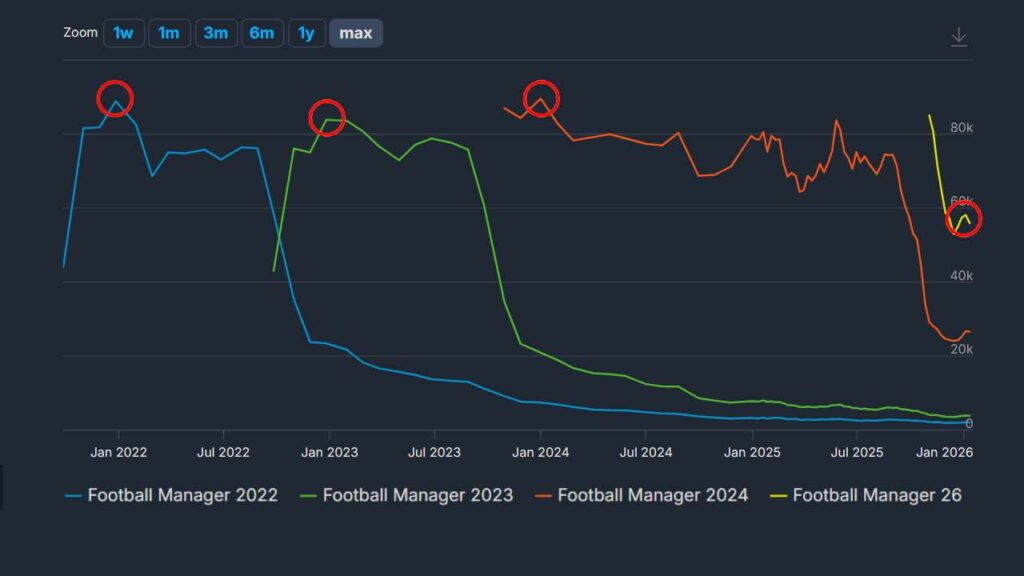
December itself saw a much steeper fall, with peak concurrency down more than 31 percent from November. That drop is normal. Almost every PC release experiences it outside of major trending titles like Arc Raiders. What is not normal is the lack of recovery afterwards.
Other indicators point the same way. FM26 currently sits around #83 for daily active users on Steam and #119 in top sellers, with little momentum from wishlists. Twitch numbers remain muted too, with peaks of roughly 1,400 viewers in the past 24 hours, a long way from launch.
Nothing here suggests disaster. But it does suggest something Football Manager is not used to: engagement levelling off early. Very early.
How this compares with previous Football Manager cycles
Past entries have followed a familiar curve.
- A big launch spike in November.
- A drop through December.
- Then a steady rise across early January that carries the game into spring.
FM23 and FM24 both behaved that way. FM24 actually hit its peak player count in January, reaching 89,478. FM23 peaked the same month at 83,715.
The series’ annual cycle and single-player focus usually allow it to retain stronger mid-season numbers than most comparable PC games. That is why FM26 looks different. It is not falling away dramatically. It is simply not bouncing back. The line is flatter at precisely the point where history says it should be climbing.
Why January engagement matters
For a single-player game, concurrent players are less about optics and more about ecosystem health.
January is when guides return. Long-term saves restart. The game’s biggest modders see renewed demand for tools and updates. Community discussion shifts away from launch reactions and into tactics, experimentation and deeper systems.
A quiet January does not mean players are gone forever. But it does slow the secondary activity that keeps Football Manager visible year-round. The game has always relied on people returning at predictable moments. January has traditionally been one of them.
Verdict
This is not a complete declaration of failure. FM26 still has a large ownership base, tens of thousands of daily players, and months of updates still to come. Player behaviour can change quickly, particularly around major patches or announcements, such as the decision to bring international football back.
What makes this moment uncomfortable is how unfamiliar it feels and how the game is performing in comparison to previous editions. For a franchise built on reliable seasonal rhythms, January has passed without the usual bounce. That alone makes FM26’s early life different from anything long-time players, or the developers themselves, have come to expect.
It could prove to be nothing more than a stumble. It could also be a much louder warning for SEGA as they look ahead to whatever comes next.