Bethesda Game Studios’ Starfield might not be the studio’s biggest hit, but it’s by far it’s biggest game. While the bulk of the studio works on The Elder Scrolls 6, which some developers wanted to work on instead of the space game, others are working on additional DLC and support for the sci-fi RPG.
The reality of the situation is that Starfield is popular, although less popular than the behemoths of Skyrim and Fallout 4 that came before it. In an upcoming episode of the FRVR Podcast, Starfield lead systems designer Kurt Kuhlmann explained that the game mostly accomplished its task, but there simply wasn’t enough hands on deck to deliver on the game that Bethesda head Todd Howard spent decades dreaming of.
Kuhlmann has explained in the past that Starfield suffered from managerial problems stemming from the fact that it was Bethesda’s first true multi-studio project and that the team scaled up to over 500 people. As they explained to us, this led to once simple tasks, such as dungeon design, taking far longer than on previous games like Fallout 4 where around 150 people worked on the main bulk of the game.
On lighting alone, Kuhlmann explained that Starfield’s production “ended up with this extremely complex process which required multiple passes, maybe even by different people, and then it had to go through a build process. So, if you wanted to change it, it had to go through that whole process again.” This was a far cry from Oblivion, Skyrim or even Fallout 4 where anyone could sketch out a dungeon and hand it to the “world artists” to create a fun sandbox to play in.
This meant that any change needed to a dungeon would take ages and would change hands constantly. The issues weren’t just stuck with lighting, either, with Kuhlmann recalling that animation had similar problems. “We ended up with a lot fewer creatures than we planned,” he said, “because it turned out that to animate a creature rig with all the stuff it needed… it was taking two or three times longer to make a creature.”
The multi-studio factor could also be a hinderance. The systems designer explained that some developers would have conversations on certain design elements which then would have to be filled in with workers in another studio afterwards. While COVID didn’t help anything, Kuhlmann explained that the entire workforce moving to a remote working situation evened the playing field whereas the hybrid approach siloed teams into their own groups.
While the scale of the team did cause issues, Kuhlmann also believes that Starfield didn’t have enough developers for the size of the game. Starfield wasn’t just an RPG; Bethesda’s latest combined the studio’s RPG formula with a massive universe, procedural generation, ship building, outpost settlements, multiple universes through new game plus, and more.
Kuhlmann explained that, in prior Bethesda titles, not much changed between games. Yes, Oblivion to Fallout 3 required a lot of new content and mechanics to be created, but a large amount of systems could be brought forward. From Fallout 4 to Starfield, almost everything was new, and it took a long time to build with developers creating content for systems that weren’t anywhere close to being online.
“We couldn’t really make it. I mean, we pulled it off to quite an impressive degree, but yeah, it was not our forte.”
Kurt Kuhlmann on Starfield
“Starfield has the problem of the new was huge compared to previous games,” he said. “So there was a vast amount of things that were just being completely changed or added. And therefore—anything new, it can’t work until it’s done, right? There were a lot of game designers were waiting… needed this new system to work before you can start building content for it. And the later that goes, the less time you have to work with it.”
While Kuhlmann laughs about the reality of the situation, they believe that Starfield needed more people to deliver on the game’s promise. “Even with the size of the team that we had for Starfield, it wasn’t big enough to create the amount of content that the grand idea of the game really required,” he says. “Like, we needed way more.”
As it stands, even with post-launch updates, Starfield can often feel bare. It’s not that there’s not content there, it’s that there’s not enough content for the scale of the universe, and the scale of the universe was the point of the game. It was designed to be the ultimate space game—for some, it still is—but Kuhlmann believes the project could have worked if there were more developers designing content for it.
“The concept of stitching procedural planets together on it, I don’t think that’s a bad one,” he said. “Except if you don’t have enough. That [idea] requires you to, for that to work and be fun, we need a huge amount of content to place so that you’re not seeing the same pieces of content so that randomness isn’t so obvious.”
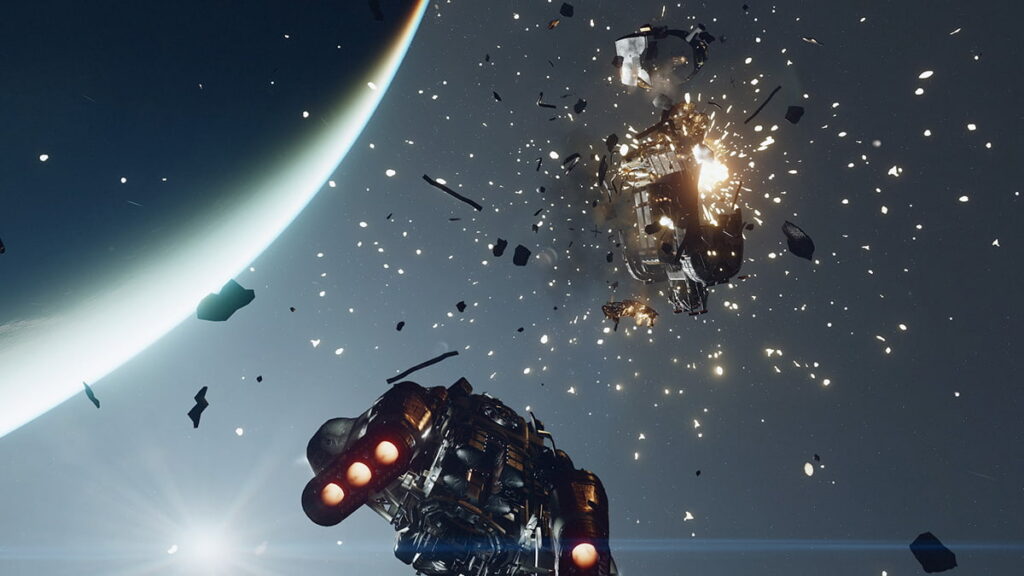
While Kuhlmann is proud of the work that Bethesda Game Studios did with Starfield, they believe the game was too ambitious. “He [Todd Howard] wanted to make a big, the open world game space game which, to him, wasn’t Skyrim in space and you just go on this one planet and then a bit on this other planet. It is what we built.
“That is an ambitious as hell vision, and I don’t think, especially in retrospect, we shouldn’t have made it. We couldn’t really make it. I mean, we pulled it off to quite an impressive degree, but yeah, it was not our forte. It was not leaning to our strengths. We had to make a space battle game right. We had never even done vehicles before.”
As Kuhlmann says, Starfield is likely the best possible version of that idea that Bethesda could do at the time. There are a tonne of learnings that could be taken to make a Starfield 2, but that will likely never happen. Really, it’s a wild dream project, and the fact that it works at all is testament to the skill of Bethesda’s developers.
Right now, Bethesda is working on The Elder Scrolls 6, which should be a more focused game than its sci-fi predecessor. After that, the developer will be moving onto Fallout 5, which likely won’t be seen until the 2030s. Will Starfield ever be seen again? Probably not.