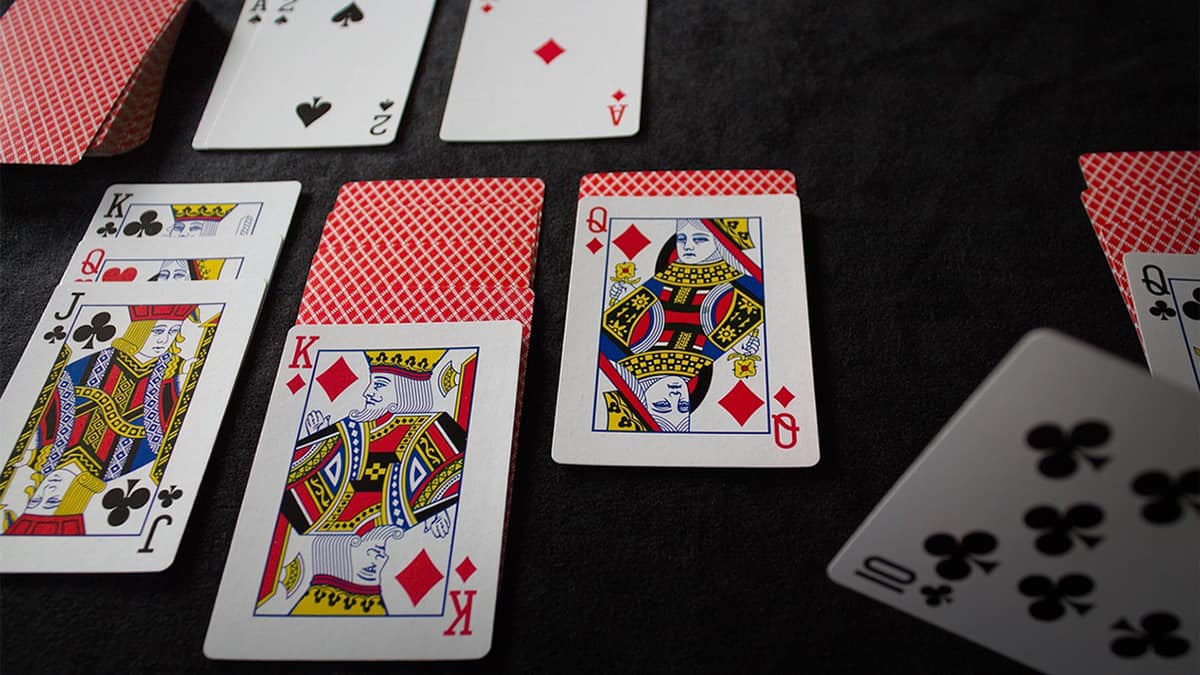
While Klondike is the most popular variant of Solitaire nowadays, thanks to coming prepackaged with Windows computers, there are far more of them out there. With its 300-year history, Solitaire (or Patience) has been reworked into dozens of variations, some of which differ by only a few rule tweaks. This is what we call a ‘family’ of Solitaire games, which all in turn fall under the original game’s umbrella. So let’s see what are the many possible variants of Solitaire, their brief overviews, and help you determine which one’s for you.
All Solitaire Families and Their Key Features
With hundreds of Solitaire variants in existence, we went on a deep dive into the major families and their most notable variants, including nested subvariants where differences are minimal. Here’s a quick whistle-stop tour before we go into more detail on each:
| Family | Decks | Key Mechanics |
|---|---|---|
| Klondike | 1 | Build tableau in alternating color, descending; draw from stock |
| Spider | 2-4 | Build tableau by suit, descending; create full sequences to remove |
| FreeCell | 1-2 | All cards visible; move via free cells; build alternating color |
| Yukon / Russian | 1 | Full tableau exposed; build by color or suit; no stock |
| Scorpion / Wasp | 1 | Partial tableau; build by suit; move entire runs or partial runs |
| Pyramid | 1 | Remove exposed pairs summing to 13 |
| TriPeaks / Golf | 1 | Remove cards by +/-1 rank relative to waste |
| Canfield | 1 | Reserve pile; build tableau down alternating; foundations start at random |
| Forty Thieves | 2 | Build tableau by suit, descending; very restrictive |
| La Belle Lucie | 1 | Tableau dealt in fans; only top card playable; build by suit |
| Aces Up | 1 | Remove lower-ranked cards of same suit; leave four aces |
| Gaps (Montana) | 1 | Reorder grid by suit and rank; fill gaps adjacent to correct card |
| Clock | 1 | Cards in 13 piles; reveal cards in timed order; luck-based |
| Carpet | 1 or 2 | Fixed tableau (“carpet”) with reserve pile; limited moves |
| Sir Tommy | 1 | No tableau; build directly to foundations; no reordering |
| Calculation | 1 | Foundations build at fixed intervals (e.g., +2, +3, +4) |
| Accordion | 1 | Stack matching cards by suit or rank; compress entire tableau |
| Demon Fan | 1 | Deal in fans; limited moves; reserve structure similar to Canfield |
| Fan / Trefoil | 1 | Tableau in fans; top card playable; build by suit |
| Matching / Pairs | 1 | Remove matching cards or make pairs (e.g., pairs adding to 13 or 14) |
| Assembly | 1 | Puzzle-based layout; arrange cards into sequences by exact order or pairing |
| Non-building Discards | 1 | No tableau build; discard by match or rank logic (e.g., Elevens, Fives) |
| Novelty / Computer-only | 1–2 | Custom layouts or rules (e.g., Joker Solitaire, Galaxy, Flamboyant) |
| Double Deck Builders | 2 | Like Forty Thieves but with looser tableau movement |
1. Klondike Family
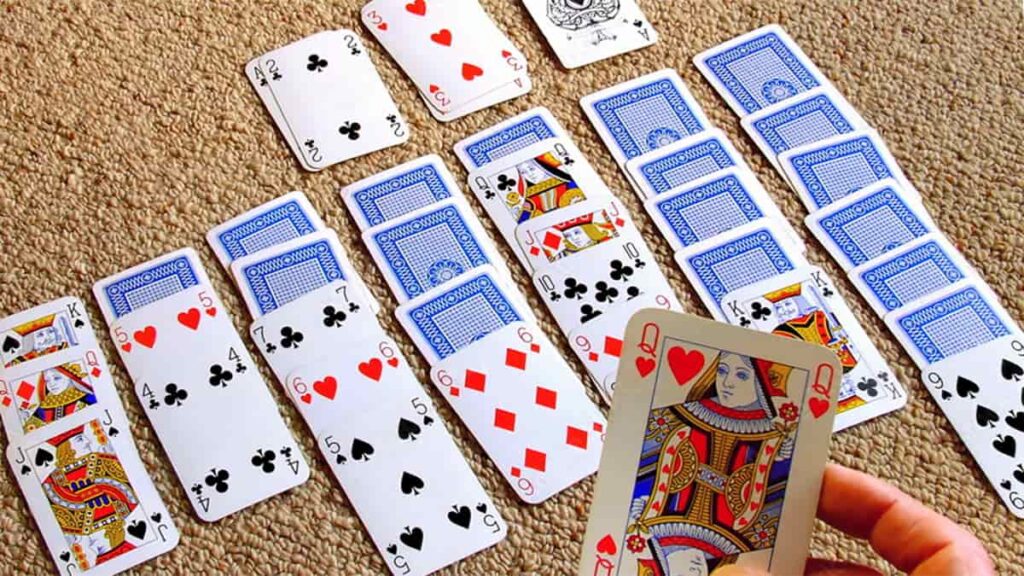
Klondike is the classic 7‑column, draw‑1 or draw‑3 format made famous by coming bundled with Windows. This well-known ruleset comes in a few other variants, including:
- Double Klondike (Double Solitaire): Competitive two‑player version with shared foundations.
- Lady Jane, Agnes Bernauer, Easthaven, Westcliff, Blind Alleys, Pas Seul, Gargantua, Harp: Variants with minor tweaks in layout, stock rules, or build restrictions.
2. Spider Family
Spider Solitaire uses 1, 2, or 4 suits of cards. The goal is to create descending suit runs in tableau. This version comes with several different variants as well, including:
- Spider 1‑Suit, Spider 2‑Suit, Spider 4‑Suit: Varies the number of card suits.
- Spiderette: Single‑deck, 7‑column mini‑Spider.
- Relaxed Spider, Simple Simon, Mrs Mop, Will o’ the Wisp, Tarantula, Black Widow, Beetle: Rules include tweaks in movement and layout.
- Scorpion (a.k.a. Spider‑style Yukon), with subvariants Scorpion 2‑Suit, Scorpion 4‑Suit, Wasp, Three Blind Mice.
3. FreeCell Family (aka Open Builders)
In the FreeCell variant, all cards are visible. There are 4 free cells to play around with, and it’s notable that each setup is almost always winnable. As with others, FreeCell has several variants, including:
- Baker’s Game: Build tableau by suit rather than alternating colors.
- Eight Off: 8 free cells, suit builds only.
- Double FreeCell, Seahaven Towers, Penguin Solitaire: Variants with more decks, cells, or piles.
4. Yukon, Russian, or Australian Family
The Yukon variant is also known as Russian, and less commonly as Australian Solitaire. The three versions aren’t interchangeable, however, with the main commonality being that the full tableau is dealt face‑up. The divergences are as follow:
- Yukon: any face‑up stack can be moved.
- Russian Solitaire: Build by suit, not colors.
- Australian Patience, Wasp: More open movement rules.
5. Pyramid and Pairing Family
Pyramid Solitaire is distinctive due to its pyramid-shaped dealing rules. The tableau is set up with cards overlapping at corners, requiring that you remove them sequentially. A pair of exposed cards has to sum to 13 to be validly removed. There are also a few variations:
- Relaxed Pyramid, King Tut (Tut’s Tomb), Double Pyramid, Pharaohs, Triangle, Giza variants based on layout or stock rules.
- Black Hole, Mixtures, Ascension, Fourteen Out, Nestor, Beehive: Pairing or adjacency discard games.
6. Golf Family
Golf Solitaire is distinctive because it changes how you have to remove the cards. You have to clear the cards to the discard pile if they’re one rank higher or lower than the top card in the pile. Its variants include:
- TriPeaks (Tri‑Towers): Three overlapping pyramids, 90% winnable.
- Black Hole, Eliminator: Quick matching games.
- Multiplayer Golf/Spit: Competitive variations.
7. Canfield (Demon) Family
Canfield, also known as Demon, is a high-difficulty Solitaire variant. It involves building up four foundation piles in suit sequence, starting with a random base card, while managing a tableau and a reserve. Its variants include:
- Canfield draw‑1, draw‑3: Variation in stock dealing.
- Related variants include: Acme, American Toad, Duchess, Seven Devils.
8. Forty Thieves Family (Double‑Deck)
Forty Thieves is a two-deck variant in which you build by suit and in 8-10 piles. Sequences in the tableau are built in descending order by suit, and only the top card of each column can be moved. This version comes with many different variations, including:
- Busy Aces, Thieves of Egypt, Diplomat, Josephine, Algerian Patience, Demons & Thieves, Emperor, Casket, Herringbone, Interchange, Breakwater, Alternations, Mount Olympus, Royal Parade, Aces & Kings.
9. Clock and Non‑Builders
Clock Solitaire is set up in a circle of 12 face-down piles, with another (13th) in the middle, simulating the face of a clock. The goal is to expose all cards in their correct “clock” positions. It’s widely regarded as a purely luck-based game. Related non-builder variants include:
- King’s Clock, Midnight, Super Clock: Subvariants that alter stack positions, reveal order, or number of passes.
- Accordion, Aces Up, Osmosis, Royal Rendezvous: Compress or remove cards by matching sequences.
10. Fan, Crescent, and Grid Games
This family of Solitaire variants is named after their layout rules. The most well-known variants in this family include:
- King Albert: Nine columns, build to four foundations.
- Baker’s Dozen: All cards face‑up, build regardless of suit.
- Carpet, Crescent, Colorado, Sir Tommy, Four Seasons, Fan, La Belle Lucie, Trefoil, Seahaven Towers, Streets, Pigtail, Flamboyant, Crossword: Unique layouts or grid mechanics.
11. Accordion Family
In Accordion Solitaire, the goal is to compress all cards into one pile by stacking cards matching in suit or rank that are 1 or 3 positions apart. Its variations include:
- Vanishing Cross, Cornerstones, Cadenette, French Revolution: Variations based on layout and collapsing rules.
12. Aces Up Family
Aces Up ( also known as Idiot’s Delight) is a variant in which you remove lower-ranked cards of the same suit to try to leave the four aces at the top. The variations for Aces Up include:
- Zigzag, Four Kings, One Pack, Elevens, Fifteen in a Row: Similar “discard and reduce” games based on arithmetic or rank.
13. Gaps (Montana) Family
Gaps, also known as Montana, is a variant in which you arrange cards by suit and rank from left to right in a grid. Meanwhile, only gaps next to cards can be filled correctly. Different variations to this ruleset are:
- Spaces and Aces, Place in Line, Sequencer, Rouge et Noir Montana: Variants that change grid size, suit rules, or number of gaps.
14. La Belle Lucie Family
La Belle Lucie is played by building 18 fans of three cards each, where only the top card is playable. Then, you have to build the tableau by suit. Its variations include:
- Three Shuffles and a Draw, Trefoil, The Fan, The Shamrocks, House in the Wood, Two Rings: All use fan layouts with rules around reshuffling, space-filling, or draw limits.
15. Carpet Games
Carpet, sometimes called Russian Carpet, involves building four foundation piles, one for each suit, from Ace to King. Twenty cards are dealt into a “carpet” grid, and the remaining cards form a stock pile. The goal is to move all cards from the “carpet” and stock to the foundations. There are a few different variants, including:
- Napoleon’s Carpet, The Carpetbagger, Magic Carpet, Persian Rug: Different tableau setups and card availability.
16. Sir Tommy Family
The Sir Tommy variant of Solitaire allows you to play cards directly to the foundation or waste piles. There are a few variations, such as:
- Aunt Mary, Grandfather, Kingdom, Number Ten, Tam O’Shanter, Hades: Vary the number of waste piles or building restrictions.
17. Calculation Family
The broadly named Calculation family features rules in which each foundation builds at different intervals (for example, 1s, 2s, 3s, 4s). The differing rules variants include:
- Musical, Interval, Calculator, Numerator: Change the sequences or rules of play.
18. Demon Fan Family
Demon Fan Solitaire involves building four foundation piles up in suit from Ace to King, and eighteen tableau piles that are built down in alternating colors. Only the top card of each tableau pile is available to play, and moves are limited to one card at a time. There are no empty spaces allowed in the tableau, and Kings can fill empty spaces. This difficult variant includes a few notable variations:
- Spider Fan, Lady Betty, Quadrangle, Sixes and Sevens, Box Fan: Focus on fan formation and restricted movement.
19. Matching/Discarding Pair Games
This Solitaire family focuses on variants that are played either by matching or discarding pairs. In some ways, it’s similar to Pyramid, with the main difference coming from the more standard layout of the tableau. The most notable variants include:
- Nestor: Remove pairs from a row of cards.
- Doublets, The Wish, Lucky Thirteen, Fourteens, Fives, Ten Pair, Sixes and Nines: All revolve around pairing, matching, or making sums with available cards.
20. Alternations and Interchange Family
These variants use suit alternation or direction alternation as the main rule. Otherwise, they are played fairly closely to the standard Solitaire variants. This family includes games like:
- Alternations, Interchange, Switchback, Dueling Deuces, Turntable: Build up and down in suit or alternate colors.
21. Assembly Solitaire
Assembly is a variant in which you move cards to combine suits or values in exact sequences. There are a few variants to this ruleset, like:
- Martha, Czarina, Harlequin, The Chest: Usually involve puzzle-like sequence planning.
22. Reserve and Tableau Builders
This broader category encompasses Soilitaire games that focus on building your tableau or reserve. Some of the notable versions are:
- Emperor, Zodiac, Canister, Maze, Fresco, Caprice, Eagle Wing, Rainbow, Tower of Pisa, Vertical, Oracle: Games that use small reserves feeding into a tableau or grid.
23. Double Deck Builders
Double Deck Builders are Solitaire games that operate similarly to Forty Thieves and also use two decks of cards. However, they are far less rigid rules-wise, making them quicker and easier to play. These include:
- Shady Lanes, Indian Patience, Zigzag Double, Two Deck Harp, Sphinx, Tanglewood: Use two decks with hybrid building rules.
24. Novelty and Computer-Invented Solitaire
These Solitaire variants are mainly reserved for gimmick games and those that cannot be played with a physical deck of cards. Instead, they require a computer to facilitate their more outlandish rules and goals. Some notable examples include:
- Solitaire Chess, Solitaire Sudoku, Kings in the Corners, Joker Solitaire, Shuffler, Thirteens Wild, Galaxy Solitaire, Rung, Xolitaire.
How many Solitaire variants are there in total?
Including named games and their well-documented subvariants, the number of distinct Solitaire games exceeds 500, especially when including:
- Print-only games from 19th-century books
- Shareware-era computer originals
- Digital variants (e.g., Microsoft Solitaire Collection)
- Casino-style betting variants (Vegas scoring)
Which Solitaire Variant Suits You?
If you’re having trouble deciding which Solitaire variant is the right one for you, then you’re not alone. With so many to pick from, it can be a daunting task. While you can try them all, of course, it could be easier if you can pick based on your tastes and goals. Here’s how we’d rank them based on interests and other parameters, so you can make the best possible choice:
For Quick, Casual Games
- Pyramid / TriPeaks / Golf: Fast-paced, light strategy, good for short breaks.
- Aces Up / Clock / Matching Pairs: High-luck, low-effort games; good for casual or younger players.
- Accordion: Quick but puzzly; visual and tactile.
For Thinking and Puzzle Solving
- FreeCell / Eight Off / Baker’s Game: Fully open information; perfect for logic lovers and perfectionists.
- La Belle Lucie / Gaps (Montana): Requires planning and visualization.
- Calculation / Assembly / Fan Games: Sequential logic with low randomness.
For Strategy, Builders, and Long-Form Players
- Spider (2–4 suits): Highly strategic, often with long play sessions.
- Forty Thieves / Josephine / Algerian Patience: Challenging and deliberate, ideal for patient, methodical players.
- Yukon / Russian / Scorpion: Open yet unforgiving; strong risk/reward decisions.
For Hardcore Players and Challenge Seekers
- Canfield / Demon / Sir Tommy: High difficulty and low win rate; very luck-influenced.
- Double Deck Builders / Demon Fan: Complex mechanics and exacting movement rules.
- Maze / Interchange / Fission: Obscure, rule-heavy, often unwinnable.
For Variety Lovers and Explorers
- Novelty / Computer-Only Games (e.g. Joker Solitaire, Crescent, Crosswords): Perfect for players who enjoy variety, new twists, or experimental layouts.
- Mixed Mechanics (e.g. Carpet, Crescent, Vertical): Hybrids of fans, grids, and foundations, great for exploring new styles.
No matter which variant you land on, Solitaire offers something for everyone. You can explore dozens of different styles and still come upon something new. We recommend trying any style that interests you and slowly making your way through everything that the world of Solitaire has to offer. Meanwhile, why not try FRVR Klondike Solitaire or FRVR Spider Solitaire? If you instead have further questions, then make sure to check out our Solitaire FAQ for answers.