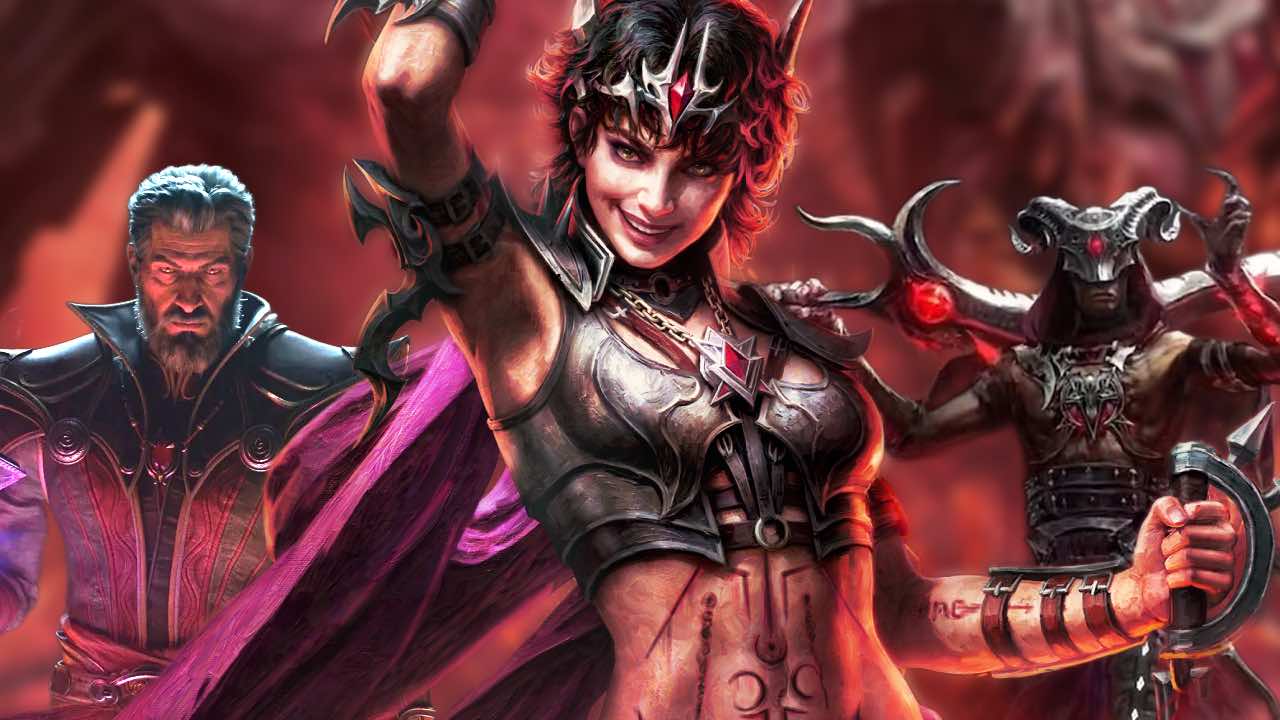
For Diablo fans, 2026 has been the Year of the Warlock. Earlier this year, Diablo 2 received its first new expansion since 2001 with its Reign of the Warlock DLC. Diablo 4 received its Warlock class alongside the Lord of Hatred expansion.
Now, the Warlock is coming to Diablo Immortal on June 17th for the free-to-play game’s 5.0 update. Coming alongside the game’s new main questline, the returning region of Lut Gholein, and three new Helliquary bosses, it’s an ambitious update. However, the most ambitious element is keeping synergy with multiple Diablo games to deliver the Year of the Warlock in the first place.
Prior to the release of Diablo 4, the existence of a new Diablo game meant the end of large-scale support for its predecessor. However, every Diablo game is essentially a forever game with hundreds of thousands of fans still playing Diablo 2 to this day. Every game in the series has its fans, and we’re now seeing a world where multiple games in the series can be supported at the same time, and this could continue into the future.
“We do with work with the D4 and the D2R team,” associate art director Emil Salim told us in a recent interview. “But, for the Warlock, I think it’s the first time that the scale was so big. Like, we’re all developing a brand-new class together at the same time.”
For Diablo’s 30th anniversary, every active game wanted to deliver something new to fans. In collaboration, every game received its own version of the Warlock with a story that connected through the three games from Diablo 2, into Immortal, and then into Diablo 4. This meant that players could see the character’s evolution with Immortal featuring the most chaotic incarnation of the character.
“I remember some of the first elements that we came up with it the elements of fire. We wanted that to be the same across all three Warlocks: the elements of chains, the elements of runes, the ability to summon and bind demons to their will,” Salim continued.
“After that we also discussed story: what is sort of the journey of the Warlock in each of our game’s timelines. Starting with D2R, where the Warlock is starting to dabble with the Dark Arts, and then we get to Immortal many years later where they’re sort of drunk with power and they’ve become quite demented, quite evil, butt hey haven’t mastered their arts. And then we get to D4 where they have fully mastered their skills in binding demons to their will.”
Game designer Kyle Anderson explains there was a collective “general vision” that “segmented” with each team making versions of the Warlock that worked within their games. While similar, Diablo 2 plays very differently from Diablo 4, and Diablo Immortal is its own beast. “We didn’t really have much communication, which you’d think would be a bad thing. But, ultimately, I think it made the product better because we had our own visions and our own designs that we believed in and knew could work for this gameplay style.”
Diablo 4 and Diablo Immortal do collaborate frequently on ideas like crossovers, such as the two games’ Berserk crossover. But the scale of synergy between Diablo 2, Diablo 4, and Diablo Immortal is something the series has never seen, and very few games have ever done. Additionally, all three of the games are still active: 4 and Immortal both have more content in the works, and there is hope for even more DLC for the second game as well. With that in mind, could we see more collaborations in the future across the three games?
“I think the three games continue to collaborate very closely,” Salim told us, “not just on classes but in a lot of other things as well. I can’t speak too much about our future plans but, I think, there’s definitely a lot more space for collaboration between the three games.”
On the other hand, Anderson explains that “the reason this came together is because of the 30th anniversary” of Blizzard’s ARPG franchise. “This was a celebration of the franchise, of the players, and what better way to do that than to give them the tools of Hell themselves?”
“It was really kind of a love letter. Like, this is a new class, a new experience for us. I think a lot of the other designs that have been done have been heavily weighed down by what has already happened. Like, you have an Amazon in one class, you have it in another. You have a Druid in one game, you have it in another. So there’s kind of this already existing tissue that you have to kind of mould and keep in mind. And this brand-new class across all three franchises let each one sing its own song. D2 fits in that world, DI fits in its world, and D4’s fits in its world.”
While the team explains that there’s definitely space for more collaborations of this ilk, especially considering the initiatives success, Anderson explains that it is a special event. “This is something special that hasn’t really been done before,” he said. “Are there opportunities for this to be done in the future? Who knows. But the reason why this happened is 100% 30th anniversary and we wanted to make it a big celebration across all of our live titles.”
It’s clear that there’s a huge demand for more content in all of the currently-supported Diablo games. In fact, it wouldn’t be a surprise if there was demand for a second Diablo 3 expansion, either. The reality is that every modern Diablo release is a potential platform, and there’s more will to support prior