Blizzard’s World of Warcraft: Midnight release date is almost upon us, adding a host of new content, as well as player housing. As the MMO’s eleventh major expansion and the middle entry in the ongoing, death-filled Worldsoul Saga, Blizzard has offered an extensive recap of the history, culture and key characters of the game’s Blood Elves race.
Additionally, the new expansion comes with sizeable revamps of Quel’Thalas, Zul’Aman and Silvermoon City zones. This is the first of many overhauls that may come to the game depending on player feedback with a major Northrend revamp planned for The Last Titan, and plans to revamp Ogrimmar and Stormwind—as well as early character race customisation—in various stages of development.
World of Warcraft associate design director Maria Hamilton explains that the new story will task players with “uniting” the Elves tribes as players return to the magical forests of Quel’Thalas, the homeland of the Bloodlands first introduced to players in 2003’s Warcraft III: The Frozen Throne. As players explore and take on new quests, they’ll understand why the Elves tribes have split apart.
“A lot of players don’t know the lore of what happened, and they don’t understand why the Blood Elves were banished,” Hamilton said. “This is an opportunity to educate those folks about that part of the story, but also set the stage for them coming together, in preparation for Midnight.“
With that in mind, below you’ll find an extensive, dense recap of World of Warcraft’s Blood Elves kindly provided to us by Blizzard that will help you get to grips with the game’s lore before you sink your teeth into World of Warcraft: Midnight on March 2, 2026. [Pre-order here].
The Flight of the Quel’dorei
The following section refers to events depicted first in Warcraft III: Reign of Chaos (2002) and later expanded upon in the novelisation War of the Ancients book trilogy (2004-2005).

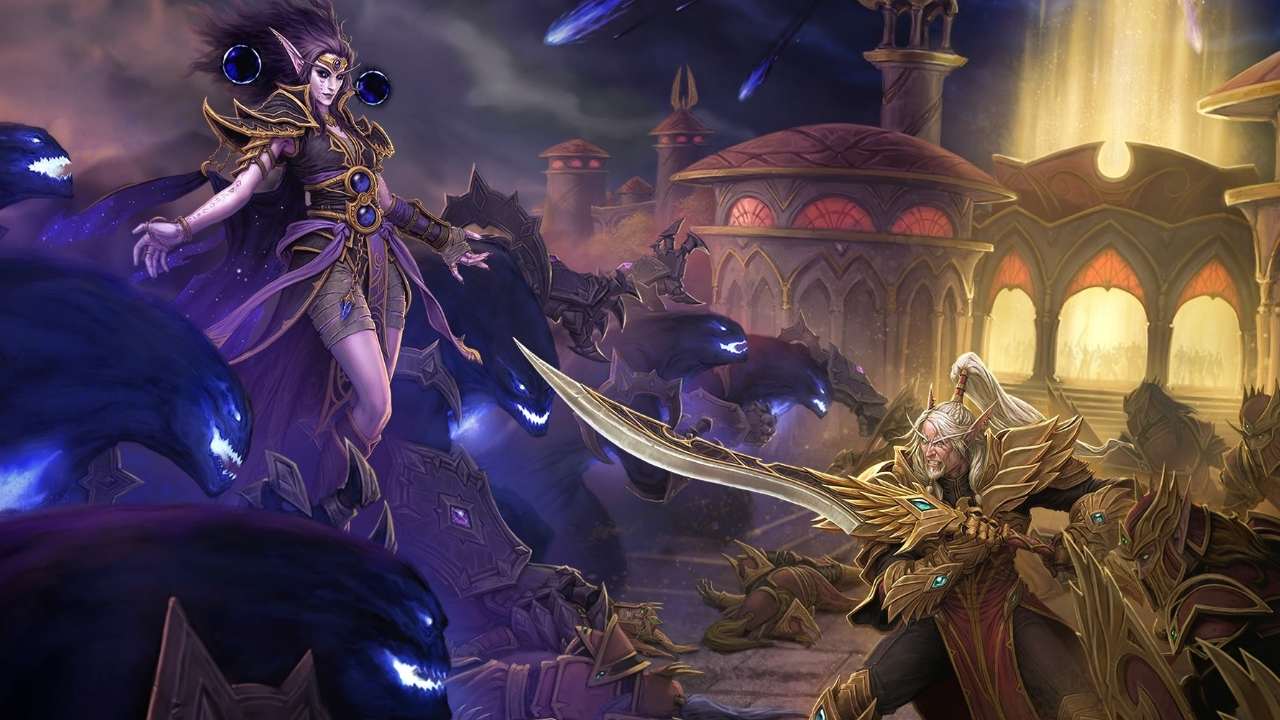
Our tale begins ten thousand years ago, at the height of the Kaldorei Empire under Queen Azshara, where an elite sect of arcane-wielding Night Elves known as the Highborne openly defied the warnings of their kin, tapping into the raw, untamed energies of the Well of Eternity. Their insatiable hunger for magic summoned the Burning Legion, resulting in a catastrophic worldwide conflict known as the War of the Ancients. The war culminated in the Sundering, a cataclysmic event that tore Azeroth apart and plunged much of the world beneath the waves. For their continued arrogance and the devastating consequences of their actions, the use of arcane was banned from Kaldorei society, and the remaining Highborne were exiled from Kalimdor.
Led by the noble Dath’Remar Sunstrider, these exiles journeyed across the perilous Great Sea, searching for a land to call home. Eventually, they found a landmass that would become known as the Eastern Kingdoms, and settled in the bustling forests of northernmost Lordaeron, whereupon they founded the magical kingdom of Quel’Thalas.
Using a stolen vial containing the waters of the long-destroyed Well of Eternity, Dath’Remar created the Sunwell and declared that it would one day surpass the power of the original well. From this day onwards, the High Elves – the Quel’dorei – were born, with Silvermoon City as their radiant centre.
The Age of the Sunstriders
The reign of Anasterian Sunstrider was first covered in the in-game book, Arathor and the Troll Wars, upon the launch of World of Warcraft (2004). This time period was later expanded with the release of World of Warcraft: Chronicle Volume 1 (2016). The later events of The Third War were primarily depicted in Warcraft III: Reign of Chaos (2002) and were included in several spin-off novels and comic books, including Arthas: Rise of the Lich King (2009).

With the Sunwell as their lifeblood, Quel’Thalas flourished for thousands of years under the rule of the Sunstrider dynasty and the Convocation of Silvermoon. Silvermoon City became a breathtaking testament to elven artistry and arcane mastery, its spires reaching for the heavens, bathed in the eternal glow of the Sunwell’s magic.
The Quel’dorei, though reclusive, were not entirely isolated. They erected powerful runestones along their borders, forming the Ban’dinoriel, a magical shield to protect their kingdom from the threat of the Amani Empire Trolls, whose ancient claims to the land were often met with bloodshed. They made alliances with the nascent human kingdom of Arathor, imparting their knowledge of the arcane arts in return for military aid, and incurring a dynastical debt to the human heirs of King Thoradin of Arathor.
Centuries later, when the Orcish Horde invaded Azeroth during the First and Second Wars, the Quel’dorei under High King Anasterian Sunstrider begrudgingly joined the Alliance of Lordaeron, hoping to repay their ancient debt to the humans. Their contribution was significant, though their commitment wavered as tensions with the humans grew, leading to their eventual withdrawal from the Alliance after the war’s end and return to their peaceful isolation.
That doom arrived in the form of Arthas Menethil, the former prince of Lordaeron, and by now the leader of the ravenous Undead Scourge. Driven by the Lich King’s will and a desire to resurrect the necromancer Kel’Thuzad, Arthas carved a path of destruction through Quel’Thalas. The Scourge overwhelmed the elven defenders, including the valiant Ranger-General Sylvanas Windrunner, whom Arthas cruelly resurrected as a banshee, and succeeded in reanimating Kel’Thuzad. In doing so, Arthas corrupted the Sunwell, leaving Quel’Thalas a scarred wasteland and its people facing near extinction.
The Rise of the Sin’dorei
The events of the fall of Quel’Thalas were first and foremost featured as the main plotline for Warcraft III: The Frozen Throne (2003). The aftermath was then presented in World of Warcraft: The Burning Crusade (2007), which added Blood Elves as a playable race to the main game. Further details to the story of Kael’thas Sunstrider were added with the novella Blood of the Highborne, as part of the World of Warcraft: Paragons (2014) collection.
In the wake of the Scourge’s devastation, the surviving High Elves found themselves in a desperate situation. The destruction and defilement of the Sunwell severed their connection to the arcane energies that had sustained them for millennia, afflicting them with a terrible magical withdrawal. Many elves would succumb to the madness, becoming known as the Wretched – withered, grotesque husks of their former selves.
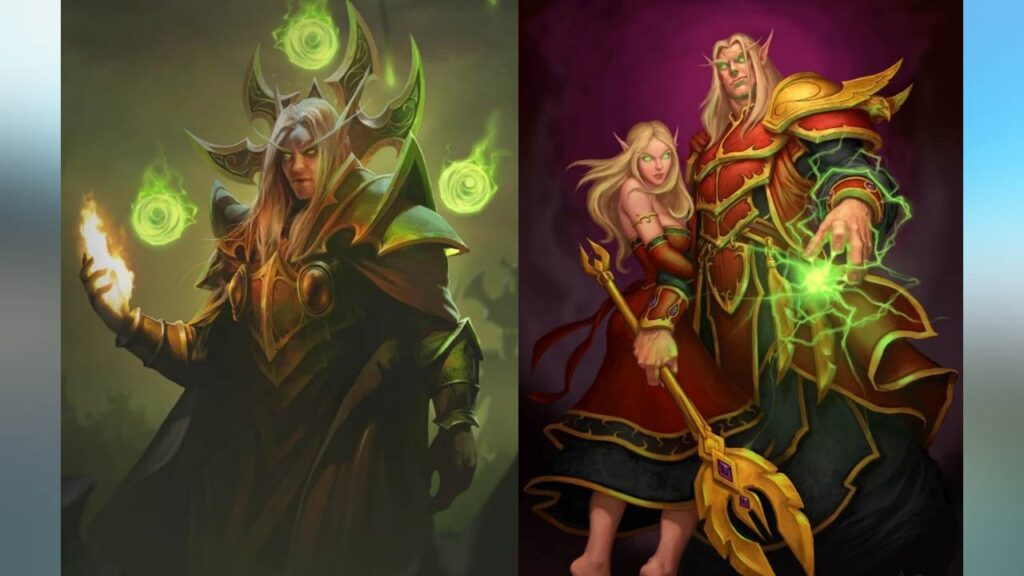
It was during this darkest hour that Prince Kael’thas Sunstrider, the last scion of the Sunstrider dynasty, returned from his studies in Dalaran. Witnessing the suffering of his people, he proclaimed them the sin’dorei – the Children of the Blood – in honour of their fallen kin. Desperate for a solution to the Blood Elves’ magical addiction, Kael’thas initially sought aid from the Alliance remnants, led by the lofty Grand Marshal Othmar Garithos. However, Garithos’s prejudice and mistreatment forced Kael’thas to seek more nefarious allies elsewhere.
The prince then forged an alliance with the reptilian Naga, led by Lady Vashj, and later with the Demon Hunter Illidan Stormrage, who promised a path to salvation. Kael’thas led a portion of his people through the Dark Portal to the shattered world known as Outland, hoping to find a new source of magic. There, the Blood Elves learned to siphon fel energies from demons, alleviating their withdrawal symptoms but at a terrible cost: a subtle corruption that manifested as green-tinged eyes and a growing dependence on this darker magic.
Despite his noble intentions, however, Kael’thas succumbed to the lure of power. Driven by ambition and perhaps a touch of madness, he ultimately betrayed Illidan and pledged allegiance to the Burning Legion’s lord, Kil’jaeden the Deceiver. He returned to Azeroth with the intention of summoning Kil’jaeden through a newly-reactivated Sunwell, intending to trigger a second invasion of the Burning Legion. Ultimately, His plans were thwarted by the combined might of the champions of Azeroth, and the prince met his end on the Isle of Quel’Danas, thereafter forever remembered for his betrayal.
The Interregnum
Many of the events outlined here span the entirety of World of Warcraft: The Burning Crusade
(2007). Several books have been published that dive into the story of Lor’themar Theron, including the short story In the Shadow of the Sun (2012) andShadows Rising (2020), which bridges the gap between World of Warcraft: Battle for Azeroth (2018) and World of Warcraft: = Shadowlands (2020). Meanwhile, Lady Liadrin served as a central character in Blood of the Highborne (2014).
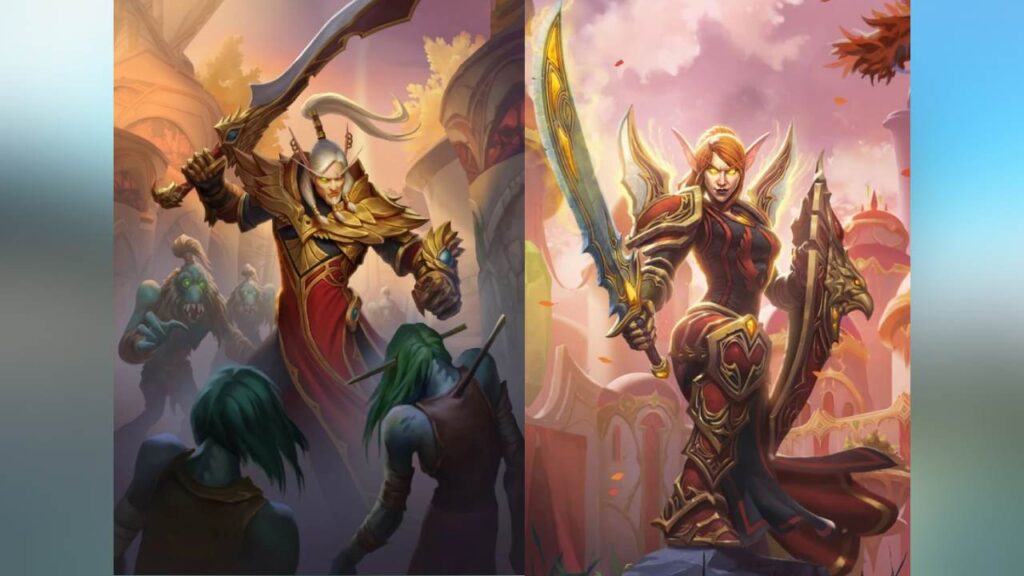
With Kael’thas’s treason revealed and his leadership decisively ended, the sin’dorei were left leaderless and adrift. In Quel’Thalas, Regent Lord Lor’themar Theron, Kael’thas’s former second-in-command, found himself thrust into the unenviable position of leading the fractured remnants of his people. The survivors of Outland also brought knowledge of siphoning power from the sentient energy beings known as the Naaru, offering an alternative source of power to the fel. This process resulted in the founding of the Blood Knights, an order of Paladins infused with the stolen Light of the Naaru, under the leadership of Lady Liadrin.
Facing a continued struggle against the Scourge in their homeland and alienated from the Alliance by Kael’thas’s actions, Lor’themar made a pivotal decision: the Blood Elves would join the Horde. This pragmatic alliance offered much-needed military support and a new path for their survival, while also providing a secure southern border with the undead Forsaken, now ruled by the Banshee Queen, Sylvanas Windrunner.
The true turning point, however, came with the redemption of the Sunwell. In a heroic act of sacrifice, the Naaru M’uru, a being of pure Light, willingly sacrificed its life force to reignite the Sunwell. This miraculous event created a font of power that contained both arcane and Light, healing Quel’Thalas and purging the fel energies from its depths. While some Blood Elves continue to utilise arcane magic, many now embrace the Holy Light (under the guidance of the now redeemed Lady Liadrin), fostering a more balanced and hopeful future.
Under Lor’themar’s steadfast leadership, the Blood Elves have played a crucial role in the Horde’s conflicts, from the frozen wastes of Northrend against the Lich King, through the cataclysm of Deathwing’s return, to the Legion’s final stand on the Broken Isles, and the Fourth War against the Alliance. Their identity has evolved, balancing their proud heritage with the lessons learned from their darkest hours, forging a path forward for the sin’dorei as a wise, powerful, and respected force on Azeroth, worthy of their namesake.
The Clock Strikes Midnight
These events are purely depicted in World of Warcraft: The War Within (2024) and will be further explored with the launch of World of Warcraft: Midnight (2026).
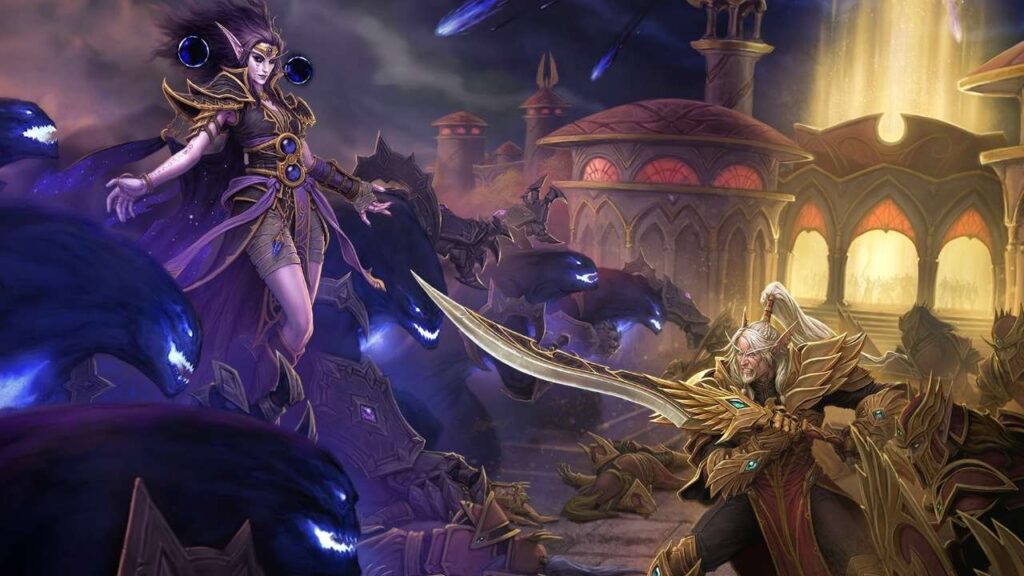
As the echoes of past wars fade, a new, ancient threat stirs. The events of The War Within on Khaz Algar and K’aresh have left Xal’atath, the Harbinger of the Void, in possession of the Dark Heart, and she is poised to commence her invasion of Azeroth.
The Sunwell, a font of incredible arcane and Holy Light energies, stands as one of the most potent sites of power on Azeroth. This fount is a prime target for Xal’atath’s dark machinations, and an assault would not only strike at the heart of Quel’Thalas but could also serve as a crucial step in the next stage of the Harbinger’s plans.
For the sin’dorei, Midnight represents the ultimate test of their resilience. Having endured genocide, magical addiction, and betrayal, they now face an existential threat that could plunge their treasured wellspring into darkness, forever extinguishing the Light that guides them. The choices made by Lor’themar Theron and his people in the coming conflict will not only determine the fate of Quel’Thalas but could very well dictate the future of Azeroth itself.
The clock strikes Midnight on March 2nd/3rd 2026, and the Children of the Blood must once again rise to defend their sacred lands.