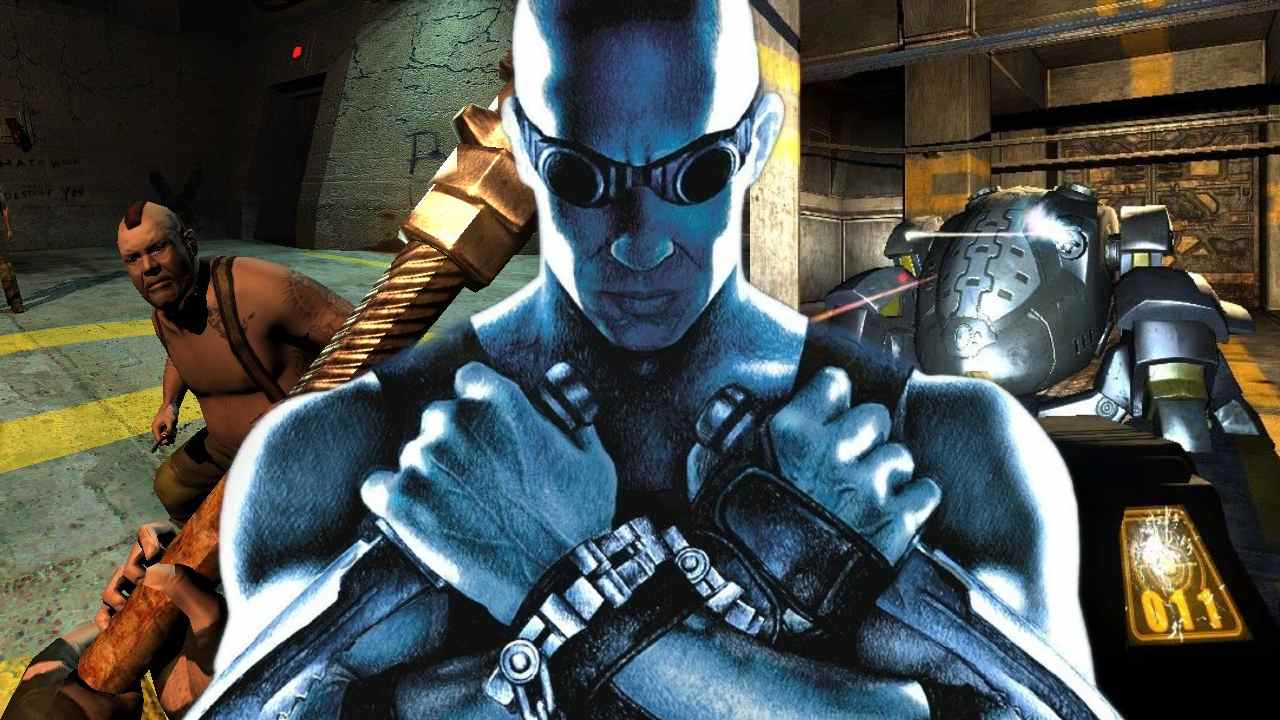
The Chronicles of Riddick: Escape From Butcher Bay was, and still is, brilliant. Arguably too brilliant in fact, as it left the middling-movies in the dust and led to the development of the far inferior Assault on Dark Athena a few years later. But take nothing away from Starbreeze Studios’ 2004 brutal first-person adventure, it’s rightly-cemented its footing as one of the greatest action-orientated games ever made.
I must have played hours of Butcher Bay, never getting bored of hearing rapper Xzibit staring me down and walking me through the vast, oppressive prison gates. Few games these days help you get lost in a world like Butcher Bay did… but why was it so damn good? Let’s take a look.
If looks could kill
Every now and then, a game comes out on a platform that shouldn’t really look as good as it does given the hardware constraints. On the PS1, Fear Effect, Metal Gear Solid and, to a lesser extent, Gran Turismo, were among titles that seemed to squeeze out just a little bit more horsepower than the hardware specs would have suggested. On the PS2, Killzone, God of War and the stunning Ico rank amongst the most visually impressive titles. On Xbox, it was Butcher Bay (and later Splinter Cell: Chaos Theory).
Powered by Starbreeze’s brilliant in-house engine, you were treated to lighting, shadows and textures never before seen on the console. Even DOOM 3, a game designed to show off the power of cutting-edge video game shadows didn’t look as good on console. Sophisticated bump mapping gave surfaces a realistic look and feel, while devastatingly realistic animations during combat, combined with state-of-the-art blood physics brought the characters to life with aplomb. When you finally got a flashlight, the dark world lit up almost photo realistically before your ‘Shined Eyes’ replaced the need for such primitive devices.
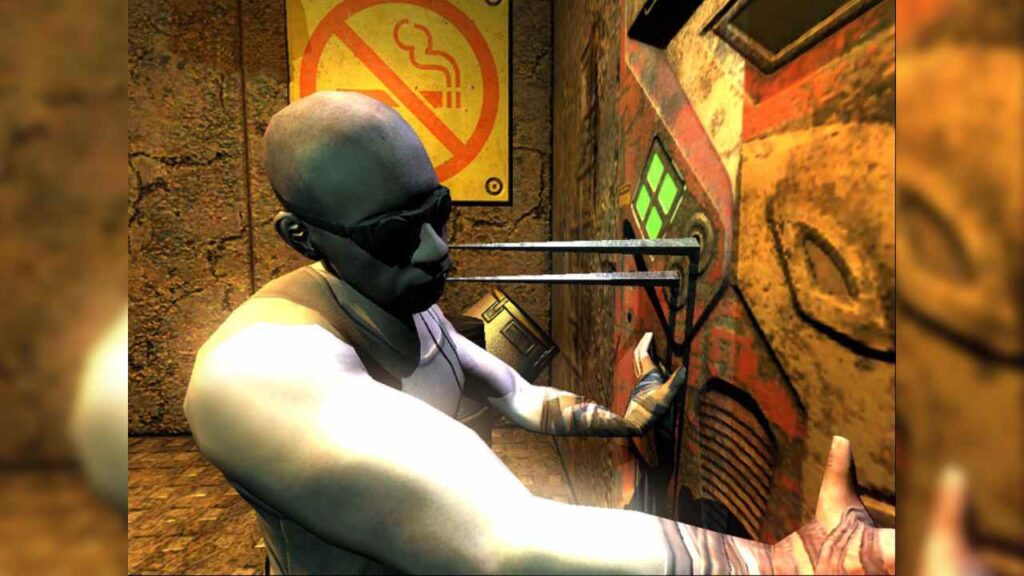
Even now, while the resolution on the console version is certainly not up to today’s standards, the sense of scale, dovetailing with razer sharp art direction, are still convincing. Blast an enemy with an automatic rifle, and you’ll see bullet holes peppered across their armor. Some games these days can’t do decals properly, or don’t even bother, but Escape from Butcher Bay’s attention to detail was just incredible, right up to the camera switching to a third-person perspective during key events, such as dialogue or using a health station.
Perfect pacing
Butcher Bay was paced perfectly. From the opening dream sequence, which gave you a tutorial of the game’s stealth and combat mechanics, to the endgame, nothing ever dragged. A big part of this was the variance in level environments. You were not just running around the holding cells, but would venture to the depths, and later heights, of the Butcher Bay facility.
Much like Half Life 2 felt like a continuous, believable journey, Butcher Bay’s level order completely made sense, and helped glue the different levels together into a believable whole. Then there was the cast, which included the likes of Cole Hauser as the detestable Johns, Michael Rooker, Xzibit and, of course, Vin Diesel. Butcher Bay felt like a Hollywood movie in a game, and while the likes of Enter The Matrix also wheeled out some big names, it never felt as ‘complete’.
Rewarding, brutal gameplay
Butcher Bay’s combat system was intuitive but also simple. Hand-to-hand combat let you parry and block incoming punches via a squeeze of the two triggers. Time it right and you’d be treated to a rewarding thump, and your foe’s face would show signs of damage – bruises and cuts forming instantly. Later in the game you get a shiv, which can be used to kill foes via silent takedowns, or finish them off with a few well-placed slices and stabs. Successful counters sometimes led to instant, satisfying kills. Hand-to-hand combat felt responsive and heavy – as you’d expect from Riddick’s bulky frame.
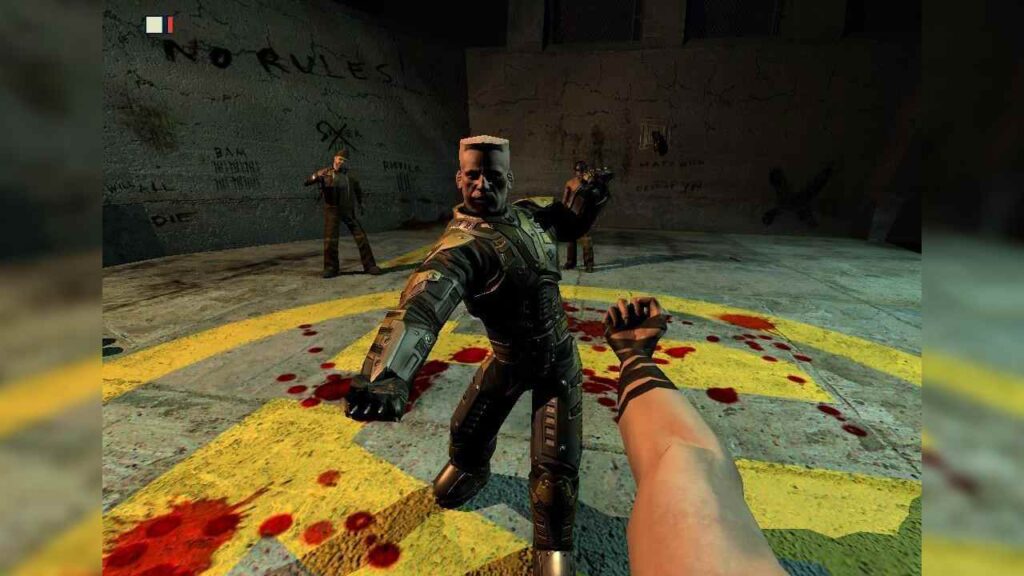
You were never made to feel superhuman, as enemy AI was too clever for that, but a force to be reckoned with. Shooting was arguably not as refined, but still fun – especially with the shotgun – thanks to some impressive ragdoll physics (although there were countless instances of bodies vibrating violently on the floor randomly), and the game scaled its weapons so well that you felt suitably powerful the entire time. It’s true that for a lot of the game weapon choice didn’t make too much of a difference, but it still felt enjoyable – a battle with Xzibit being a particular highlight.
Butcher Bay was, and still is, a lot of fun. An instantly playable classic that I’d encourage anyone to dive into and play. Don’t let the mediocre movies put you off – this is a classic, but it’s largely unplayable today, at least without a lot of technical finagling.
It’s time for a recall
The Chronicles of Riddick: Escape from Butcher Bay has already been remastered once, and it didn’t go down well. Included with the underwhelming Escape from Dark Athena sequel, the Xbox 360 and PC remaster of the game changed the entire vibe of the stealth-action game and suffered heavily as a result.
For a true remaster, Riddick needs the attention afforded by studios like Nightdive, a studio that cares about retaining as much of the original as possible. Escape from Butcher Bay’s original art style is gorgeously imposing and brutalist, and it deserves to be brought back in HD with slick framerates and the return of its sublime audio for modern gamers. I got to play Escape from Butcher Bay as it was intended, and other players should as well.