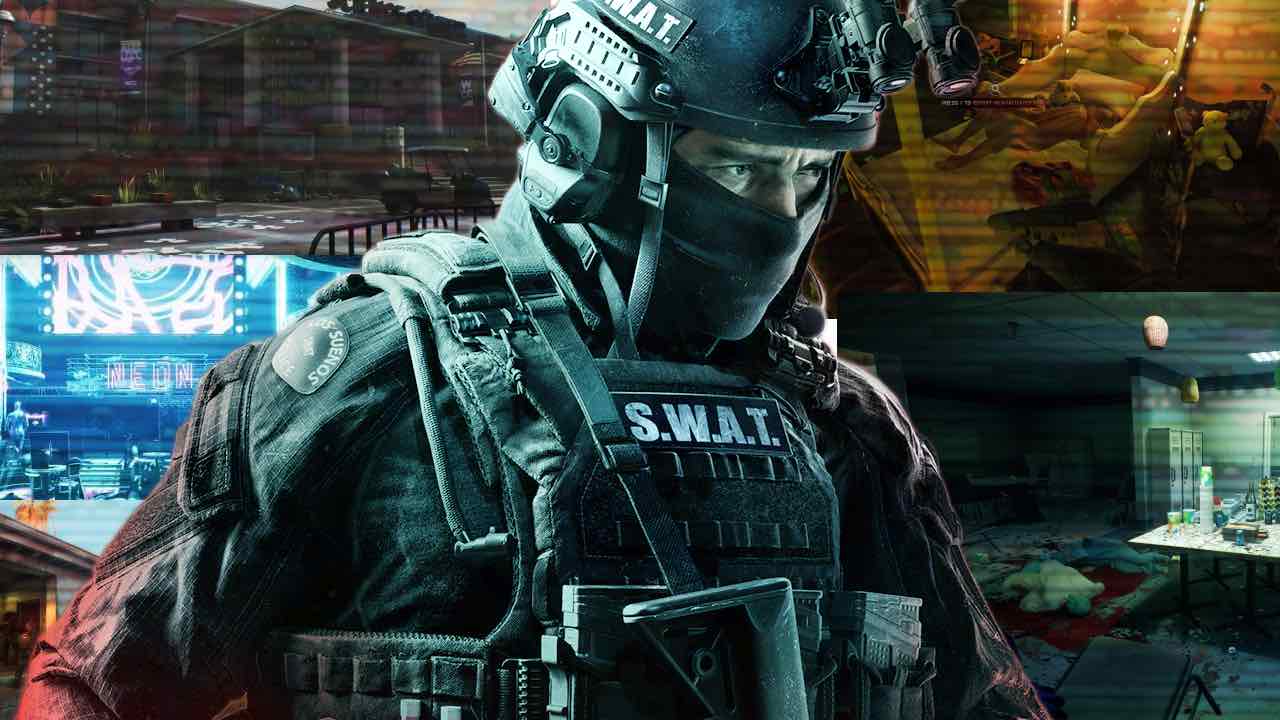
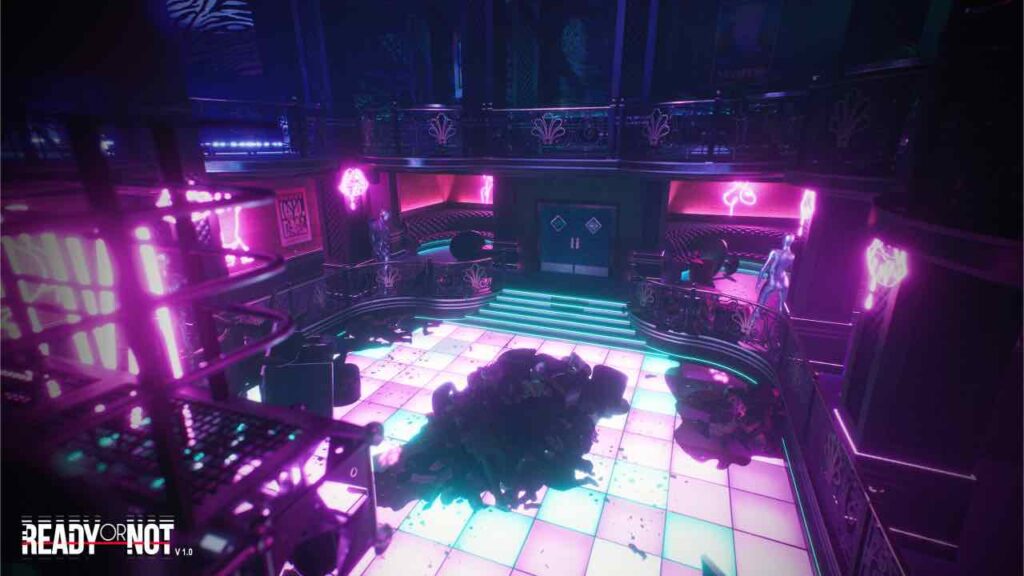
Neon Tomb is a nightclub too loud for its own good. Occupied by terrorist cell The Hand, the thumping bass of the slaughtered DJ’s looping set is headache inducing, the bass punching through your headset as you move past piles of bodies, broken glass, and phones screaming with a painful polyphony of loved ones terrified that their child, spouse, friend, won’t be coming home. They won’t be.
In moments like this, Ready or Not is one of the most enthralling FPS games you’ll ever play. As you slowly sneak through the nightclub, peeking corners and taking out offenders, there’s spikes of adrenaline you would never feel in any other title. There’s a realism here—the pound of the bass coincides with outburst of your flashbang as you cuff another suspect. When everything lines up right, you are truly in that space.
Ready or Not is a game that has been met with some controversy. The aforementioned nightclub mission is quite clearly inspired by the 2016 Pulse nightclub shooting. Another mission, Elephant, is also controversial, this time inspired by the 2003 Columbine shooting and named after a movie based on the horrific events.
VOID’s SWAT simulator has certainly drawn the ire of many over its attempts to replicate such horrific events—incidents that continue to occur at unequivocally horrendous quantities. Columbine is a horrific event, of course, yet it now sits at the 6th deadliest school attack in America with four of the succeeding five occurring after 2003. In its quest for realism, shouldn’t art by granted the ability to adapt events that churn our stomachs?
If video games are to be considered art, then games should exist that make you uncomfortable. Cesar A. Cruz once said that art should comfort the disturbed and disturb the comfortable. In the same way that Brett Easton Ellis’ American Psycho, Allen Moore’s From Hell, or Jeremy Saulnier’s Green Room are largely disturbing pieces of art, Ready or Not disturbs in similar ways.
There are moments in VOID’s shooter where your heart can sink in a way few video games will ever recreate. The first time you see a convulsing child in Twisted Nerve; the first time you see photos of victims at Brixley Talent Time; the first time you walk past the bodies piled in the hallway of Neon Tomb.
Every level starts off as a tactical horror game as you learn enemy paths and discover what’s around every grisly corner. Then again, the horror of the situation is quick to dilute. The first time you see the horrific image of a convulsing child in the room of a meth den is horrific, by the tenth time, you barely even look through that room. Similar to the shock of Modern Warfare 2’s No Russian, what starts as a traumatic event eventually becomes a fun set piece. In itself, that turns has more artistic merit than a lot of titles these days, even if it serves an unintentional byproduct of gaming as a medium.
Nevertheless, each level in Ready or Not is still thrilling, helped by truly spectacular sound design and weapons that feel as scary to use as they are to be attacked with. The issue, though, the one core flaw that blares like a neon sign throughout even the darkest missions of VOID’s shooter is that it is also technically incompetent.
Years after release, the seams of the game’s brilliant simulator gameplay are not only visible, but pulsating and septic. Enemies jitter through the floor as you cuff them; friendly AI will reverse into a room with their riot shield instead of protecting themselves; civilians will run into enemy fire; enemy evidence phases into a liminal space every two missions. At one point, spent bullet casings would remain in the air, and the game’s sound would simply cut out and come back at extreme volume every five minutes.
There is a clear intent with Ready or Not that is consistently hampered by its technical fallacies, and always has been. For every time the game makes your hair stand on end, it pratfalls into the mud. Its tone often buckles under the weight of its legacy glitches, exacerbated by the introduction of new glitches and quirks with every update. In hindsight, it’s almost a miracle that the game remains so good to play. Whatever intent Ready or Not has – whether educational, informative, or otherwise – is so often ruined by the game’s inability to keep its virtual stomach from upchucking in front of the player.
With near 100 hours of playtime, the haunting effects of Ready or Not have mostly waned, but the SWAT game still miraculously remains an FPS great. It’s likely one of the best broken titles around. Its flaws are unilaterally exceeded by the quality of its environments and the rawness of its combat. Its AI enemies break often, but when they come together in unison to simultaneously breach doors and pincer you, there’s not a single game like it.