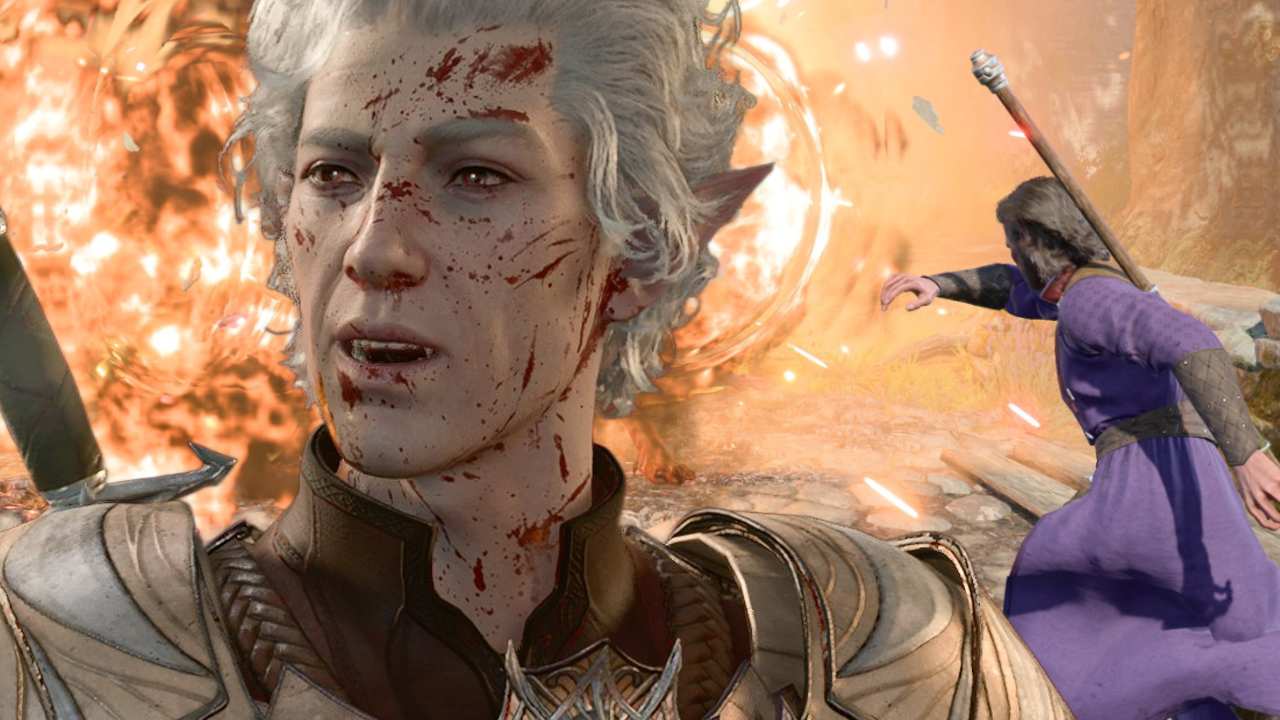
Larian Studios’ Baldur’s Gate 3 is a huge technical advancement over the studio’s last game, Divinity: Original Sin 2. With BG3, the team introduced full motion capture cutscenes, many of which were performed by Astarion actor Neil Newbon, which was only possible to a major game engine revision.
Baldur’s Gate 3 was built in Larian’s in-house Divinity Engine, a toolset which has been upgraded for the development of its upcoming Divinity game. While the engine that powered Baldur’s Gate 3 was a huge step forward for the studio, it still had some major limitations. (And that’s not including the thing about ladders!)
In the latest issue of EDGE Magazine, which is currently rolling out to subscribers and retailers, Larian Studios technical director Bert van Semmertier explained that Larian “deliberately stay a bit behind the curve” when it comes to its in-house engine. While Baldur’s Gate 3 looks fantastic, it isn’t as cutting-edge as other titles graphically, and that’s by design.
As the technical director explained, if Larian wanted to keep up with the likes of ray-tracing or massive crowd sims, it could, but keeping their games in scope to the team’s current size is incredibly important for a team that started out with just a handful of developers.
“If the vision was to allow the simulation and rendering of hundreds of characters in a single location, we would sit together with a part of the team and discuss requirements and potential solutions,” he said. “Having ownership over your engine allows you to anything you want, basically.”
While this is true, there are always some limitations that take a long time to overcome, and van Semmertier explained that Baldur’s Gate 3 suffered from a major technical restriction. “A longstanding limitation we had in multiplayer is that players could not cross acts individually. You always needed to transition together as a party, and this had an impact on how we built our world and how the story needed to be structured”.
This limitation doesn’t just effect the main released game of Baldur’s Gate 3, but also the creation of mods. Huge custom campaigns, like the in-development Path to Menzoberranzan, must all play by the same rules, sometimes with additional restrictions, but Larian has worked tirelessly to make sure that this limitation is not present in their upcoming Divinity game.
“In the next iteration of our engine, this is a limitation we have completely removed,” the technical director said. “There is no limitation anymore on how big an act can be.”
Larian Studios’ next game, Divinity, has been described as “Larian unleashed”, with CEO Swen Vincke explaining that the RPG will be the culmination of every lesson the studio has learned over the last two decades. While the game has already seen some controversy, such as the use of generative AI in pre-production, the game is now in full production.
Unfortunately, Larian won’t be continuing its adventures within the world of Baldur’s Gate, although Hasbro has claimed that Baldur’s Gate 4 is “of course” going to happen under a new studio. Additionally, although Larian is not involved, a continuation of BG3 is coming in the form of a live-action HBO series sometime in the future.