
Epic Games CEO Tim Sweeney is continuing his long-standing protest against Steam’s AI disclosure policies.
Amidst the horrors of this year’s slop-filled Steam Next Fest event, Steam users are calling for an AI filter that would allow them to block AI slop games from their discovery feeds. With the catastrophic rise in the number of Steam releases now bogging down the storefront even further, some fans feel this would create a much nicer environment to find new, passion-filled games.
Sweeney has already pushed Fortnite and Unreal Engine creator Epic Games into a Pro-AI stance. Now only is the studio actively using AI for Fortnite collaborations after laying off 1,000 developers earlier this year, but the studio is reportedly forcing AI usage for the development of a new Disney live-service game.
In a series of statements on social media, Sweeney claimed that forcing AI disclosures on a game means forcing developers to write a “political statement” when selling their games. “Forcing developers to write a political statement to be used against them by the hate mob they’re helping organise is abhorrent,” Sweeney said.
Sweeney continued to state that AI disclosures are the same as “forcing developers to list their voting history to drive cancel campaigns and public struggle sessions”. He continued: “There is a real economic cost to Valve’s foray into forced political disclosures. Besides taking 30%, they’re also taking a potentially even larger fraction of developers’ revenue and livelihood by undermining their business with these AI hate campaigns.”
The reality, though, is not entirely on Sweeney’s side. Arc Raiders, one of the best-selling games of 2025 has sold over 16 million copies since launch. The game slipped past Battlefield 6 as the best-selling game of last year’s winter period, and made back over six times its budget in just a few months. This is despite the fact that the game has a clear AI usage disclosure on the bottom of its Steam page.
Other games as well have seen major success on Steam despite their AI disclosures, including the extremely egregious AI use in Call of Duty: Black Ops 7. Some games built with Generative AI at their core have also seen success, such as Teach My Little Sister How to Drive, a game that was so popular that its developers had to take out a loan to fund its AI token usage. Librarian: Tidy Up the Arcane Library also disclosed its AI use, and went on to become a viral indie game.

The question then is why should developers hide their use of AI? For those who care little, the disclosure means nothing, and for those who have nothing to hide, it’s simple transparency. Just as vegan-safe food has a vegan sticker on it, those who don’t wish to partake in AI-made media should be free to know what games they deem worthy of their time and money.
This is a sentiment that Sweeney’s company itself supports, albeit not for consumers. As pointed out on social media, Fab, the Unreal Engine asset marketplace, asks users to disclose if assets were made with Generative AI or without it. If a seller doesn’t disclose this information, they can’t sell assets on the Unreal Engine marketplace.
“This is a business to business marketplace. Many Fab customers are operating under contracts that require them to understand the providence of all content in their game (including Steam’s own contract that I’ve complained about) and they cannot buy assets without this info,” Sweeney stated online. In Sweneey’s own words, artists using Fab have to make a “political statement” to sell assets.
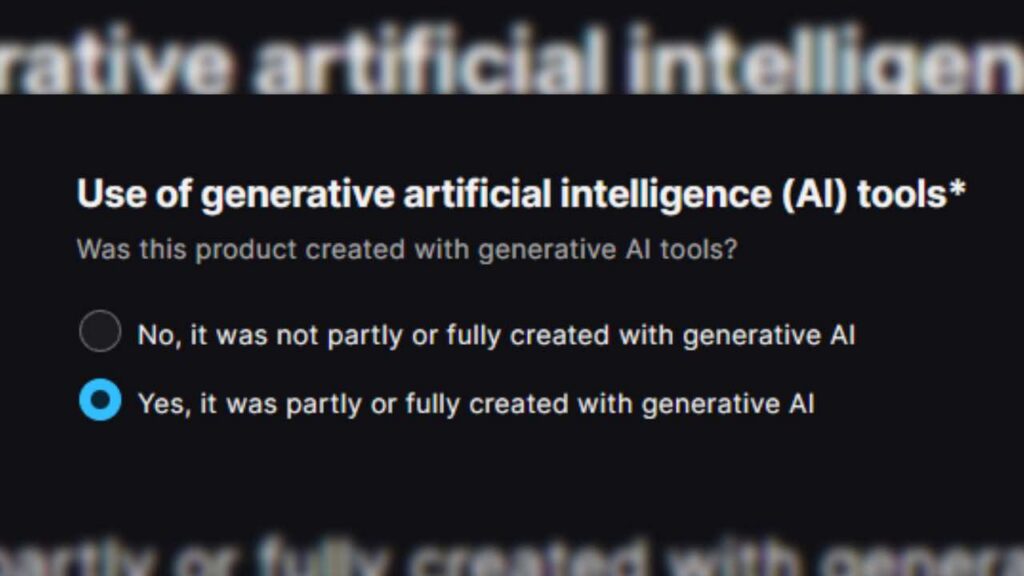
The simple answer is that disclosures are the right path forward. If AI is to be seen as a tool for good, then users should know when it is used and see it proudly displayed. On the other hand, if users don’t want to play games with Generative AI, that same disclosure lets them know if they should avoid a game entirely. More detailed AI disclosures also let consumers draw the line where they want. Maybe a consumer doesn’t mind AI code, but hates AI art, music, or voices.
At the end of the day, Sweeney’s tirade against AI disclosures are inconsistent and anti-consumer, pushing for less transparency with players. Furthermore, Sweeney is calling for less autonomy for businesses themselves. Right now, Steam is the only mainstream storefront with AI disclosures: Xbox, PlayStation, Nintendo, and GOG do not require developers to state whether or not they’ve used Generative AI in their games.
Additionally, Sweeney has their own mainstream games marketplace, the Epic Games Store, which also doesn’t require devs to disclose whether or not they use AI. EGS, the home of Fortnite, is probably what the Epic CEO should be focusing on, especially as its new AI-made “vibe-coded” launcher is an absolute shambles, and they proudly disclosed that thing’s use of AI.