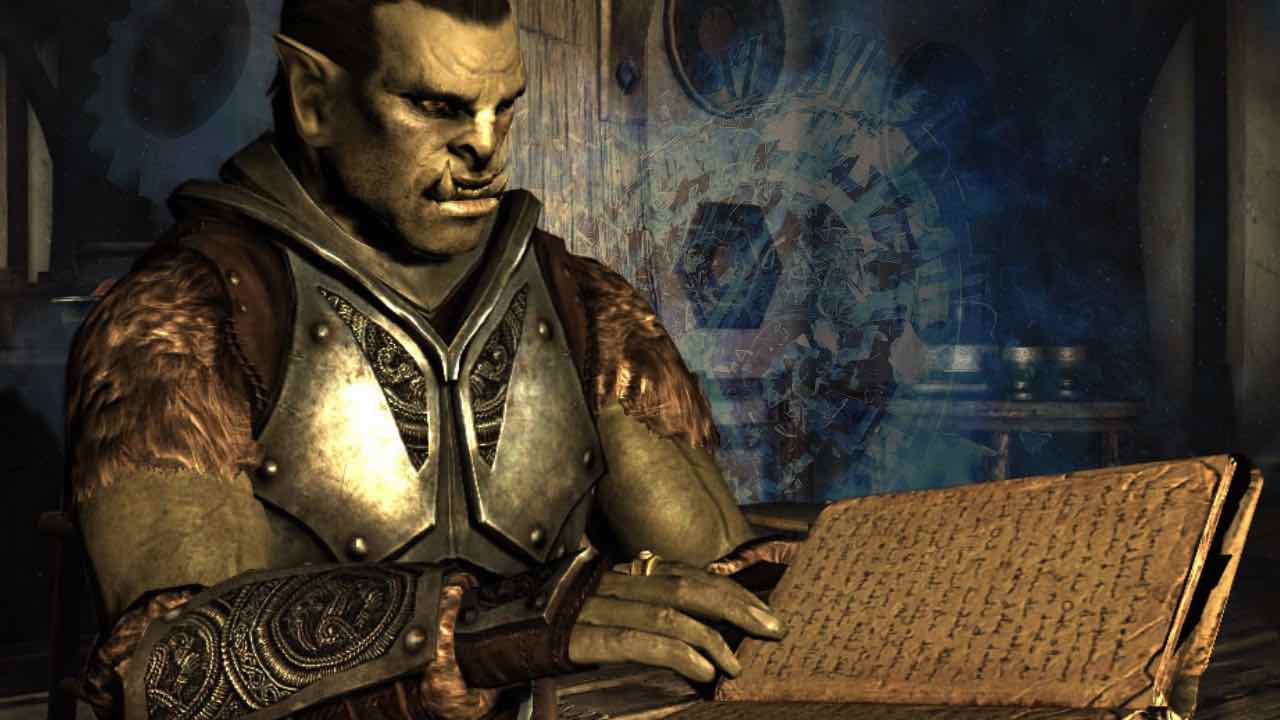
Bethesda’s long-running The Elder Scrolls series is now in-development of its sixth mainline entry. Since its inception, every mainline game has followed in chronological order, usually with large breaks, with in-game lore filling in the gaps with NPC dialogue and history books informing you of what happened between multiple entires.
For former loremaster and Skyrim co-lead Kurt Kuhlmann, the way in which The Elder Scrolls handles its storytelling is one of the greatest strengths of the series in that its all told in a very human way. Stories are passed down and often contradictory with players often having to piece together an unreliable history in the same way that we do with our own ancient texts.
One of the most unreliable parts of The Elder Scrolls’ universe is the possible inception of the Dragon Break, a period where linear time completely shatters as the God of Time loses control of the timestream. During this period, multiple contradictory timelines all occur at once… or do they?
Speaking to FRVR, Kuhlmann explained that the Dragon Break was conceived by writer Michael Kirkbride as a response not only to Daggerfall’s multiple endings, but also due to the fact that there was a typo in the official timeline that caused a jump in time by 1,000 years.
“It came from the fact that there was this timeline that someone had made, this was in the Daggerfall days, and there was this big gap in time. I am 100% convinced that in reality, in our real world, it was a typo,” Kuhlmann said. “Someone just typed the date wrong in the timeline so they skipped like 3,000 years or whatever by accident.”
Kuhlmann explained that Michael Kirkbride “thought that was awesome” and leaned into the “metaphysical” angle, conceiving the Dragon Break as a way to explain away both the endings of Daggerfall and the timeline’s discrepancies. Kuhlmann, on the other hand, provided the opposite solution, creating the “in-world historical” texts that sought to disprove the existence of the Dragon Break as clerical error or fantasy in a fantasy world.
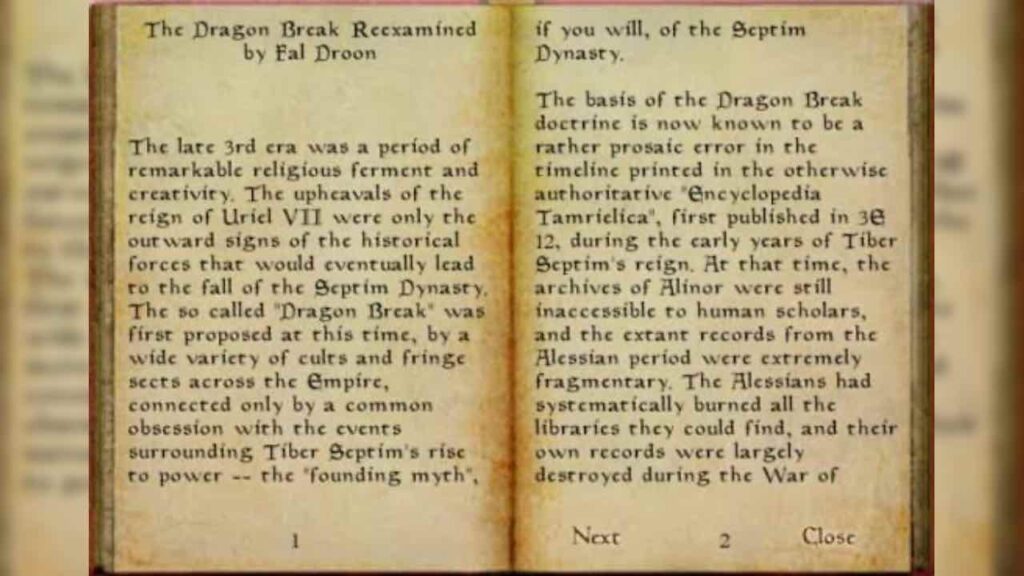
“[It’s] is a very typical thing in history where the monks are copying out these chronicles, and then 100 years later some other monk copies it again because it was falling to pieces, or whatever, and he’s sleepy, or he just makes a typo, and he writes it wrong. And then the only thing we’ve got is the copy of the copy of the copy and it’s got this thing in it and people try to figure out what it means, and it actually turns out it doesn’t mean anything.”
For Kuhlmann, that’s one of the strengths of The Elder Scrolls and Bethesda’s format of storytelling. There’s a human unreliability to a lot of what you’re told which can lead some players to take different sides or view the fantasy world differently to one another.
“To me, that’s one of the best things about The Elder Scrolls, is that everything is in world. We don’t give you the Dungeon Master’s guide to history. The only thing you know about is from the point-of-view of someone in the world which is how we experience the world, also. We don’t have an authoritative version of what happened in the time of the Egyptian Pharohs. We have records and we have to piece it together. Here’s a book someone wrote: how much of that is actually true, do they actually know this? Do they have an agenda? That’s history.”
Kuhlmann explained that this doesn’t only serve to make the world of Tamriel feel more lived in and more real, but also “extremely flexible from a game developer’s point-of-view”. The designer explained: “We can deny anything. Now, you don’t want to. You need to have some facts, so the basics you don’t want to upend for no good reason.”
With that said, Kuhlmann explained that it’s not a great idea to change pre-existing lore unless there’s a really solid reason to, and they only chose to change so much after Daggerfall due to the nature of its split ending. “Really, Daggerfall was the only game where we had to deal with that in a big way,” he said. “I guess Skyrim has the ‘who won the civil war’ question, which they’re gonna have to deal with probably in TES6, or they’ll just ignore it. I assume they’ll have to at least talk about it a little bit, about what happens, because it’s set in the future.”
The Elder Scrolls’ approach to history may not be unique in how we perceive it, but it is unique in fiction. In the push to canonise everything, there’s often very little room for historical failings or vague interpretations, which are often the foundation of history. To this day, we don’t know the exact engineering of how Egyptians built the pyramids; we’re not exactly sure where, when, or if Jesus was crucified. These unknowable truths, while often frustrating, span much of history, and Tamriel’s virtual world feels real largely because we don’t know everything.
For more from our time with Kuhlmann, read about why the designer believes Black Marsh would be a great, but likely improbable, location for a future Elder Scrolls game. Additionally, read their thoughts on the continuing Xbox layoffs, and what it actually means for studios such as Bethesda.