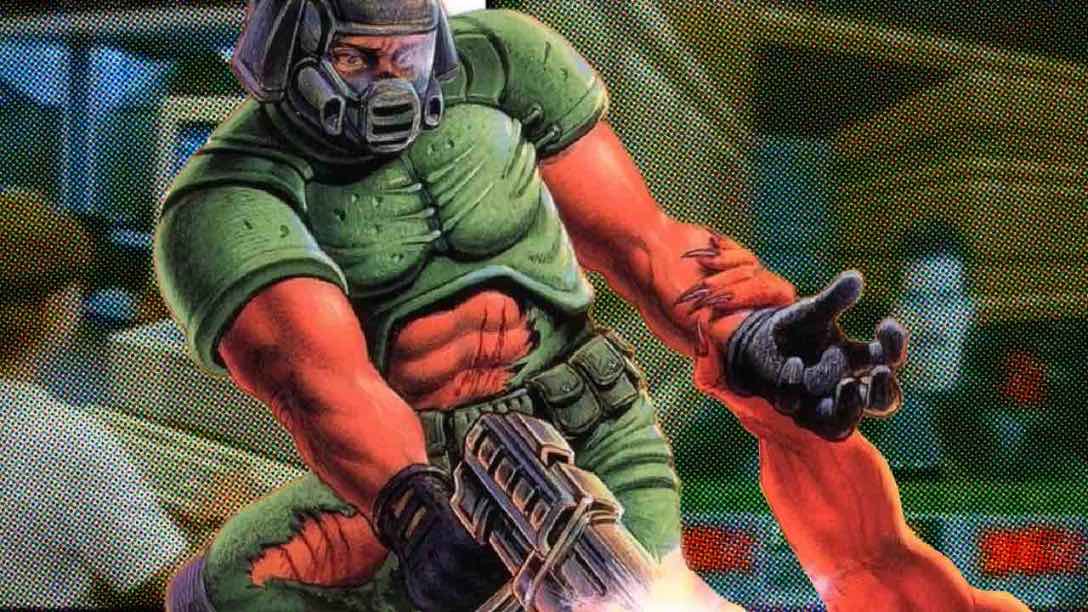
In just a few weeks, Id Software’s DOOM celebrates its 33rd birthday. The iconic shooter changed the gaming landscape for everyone, pushing forward the FPS genre, PC gaming, and violence in video games.
While tame today, DOOM’s adorably rudimentary pixel-art violence was controversial back in 1993. “The funny thing is that it is of its time. It’s contextual,” co-creator John Romero tells us in a new interview.
While 2026 has hyper-realistic executions in Mortal Kombat 1 and dismemberment in countless titles, the retro shooter’s puddles of blood and gore were the height of video game violence during its release. “In 1993, no one had ever seen anything like that before,” Romero said.
“Now I know how Gary Gygax felt when he made D&D.”
John Romero on his reaction to video game violence protests.
DOOM’s perceived hyper-violence was obviously praised by fans and game reviewers, but criticised heavily by political figures. In 1993, the United States senate held a meeting on video game violence, but Id’s shooter wasn’t mentioned. In 1999, however, the horrific Combine High School occurred and DOOM was blamed as Eric Harris and Dylan Klebold were said by so-called “experts” to be inspired by the game.
“They were known to enjoy Doom, a video game licensed by the US military to train soldiers to kill,” the article reads. “In a classroom project the pair made a videotape of their own version, in which they dressed in trenchcoats, carried guns and killed school athletes… One researcher described Harris, 18, and Klebold, 17, as ‘playing out their game in God mode’.”
At the time, Id Software was used as a scapegoat for the Columbine shooting. “It was kind of like, ‘well, now I know how Gary Gygax felt when he made D&D,” Romero told us. “So many articles about D&D about people killing themselves in tunnels, re-enacting and larping and stuff. And stuff that didn’t really happen, but there were a lot of people who thought that it was real.”
Romero grew up on heavy metal music, Dungeons and Dragons, and all manner of material that was labelled as ‘devil worship’. While the media hounded the developers for releasing DOOM years after the game’s actual release, Romero explained that they simply couldn’t understand where the hysteria was coming from.
“We figured that we’re just sane people,” Romero explained. “We didn’t do anything bad because we played D&D. I didn’t do anything bad because I listen to heavy metal. I’m making cool games. I’m not doing anything outside of work because I’m making these games or playing this game. So it just made sense that if somebody did do anything like that, it wasn’t the game. It was something else.
“It had to do with their home life or their brain, their chemical balance or makeup or whatever. Maybe they’re bullied. I mean, people have a lot of things going on. So it was obvious to me that it was not [the game]. Don’t blame the game or heavy metal or comic books or D&D. Don’t blame any of those things. It’s something else.
Romero explains that DOOM being labelled as an inspiration for the Columbine shooting is simply because “it was something that they played”, adding “they played a lot of other games too”. As for why the FPS game was immediately used as the scapegoat, the co-creator argues that it’s likely simply due to the game’s continued popularity during that period.
“DOOM was everywhere. It was hard to get away from DOOM. Like 1994, you’re reading a game magazine? You were reading about DOOM… it’s non-stop,” he explained. Even in 1999, despite other games coming and going, the game was still talked about, levels were still being made, and new ports were still releasing. Despite its age in 1999, it was still killer software.
To this day, Romero still doesn’t quite understand the pushback against the game by certain groups. “When you’re killing demons in DOOM, you’re doing good,” Romero said. “So, what’s the problem, right?”
DOOM today is significantly more violent than the DOOM of 1993, and no one is blaming DOOM: The Dark Ages for the ever-present violence of modern America. Instead, modern studies explain that violent video games inspiring real-life violence is merely a myth, as well as “a dangerous distraction” from the real issues.
33 years after DOOM’s release, the majority of regular, sane people would agree that it couldn’t possible be the cause of such a horrific event. But them, as Romero explains, DOOM was revolutionary at the time; it looks almost rudimentary now compared to the quality of modern AAA game releases, but it was once the peak of realism in games. Blaming DOOM was obviously wrong, scapegoating its creators was wrong, but when has a so-called “moral panic” ever been fuelled by anything other than fear, confusion, and hysteria?