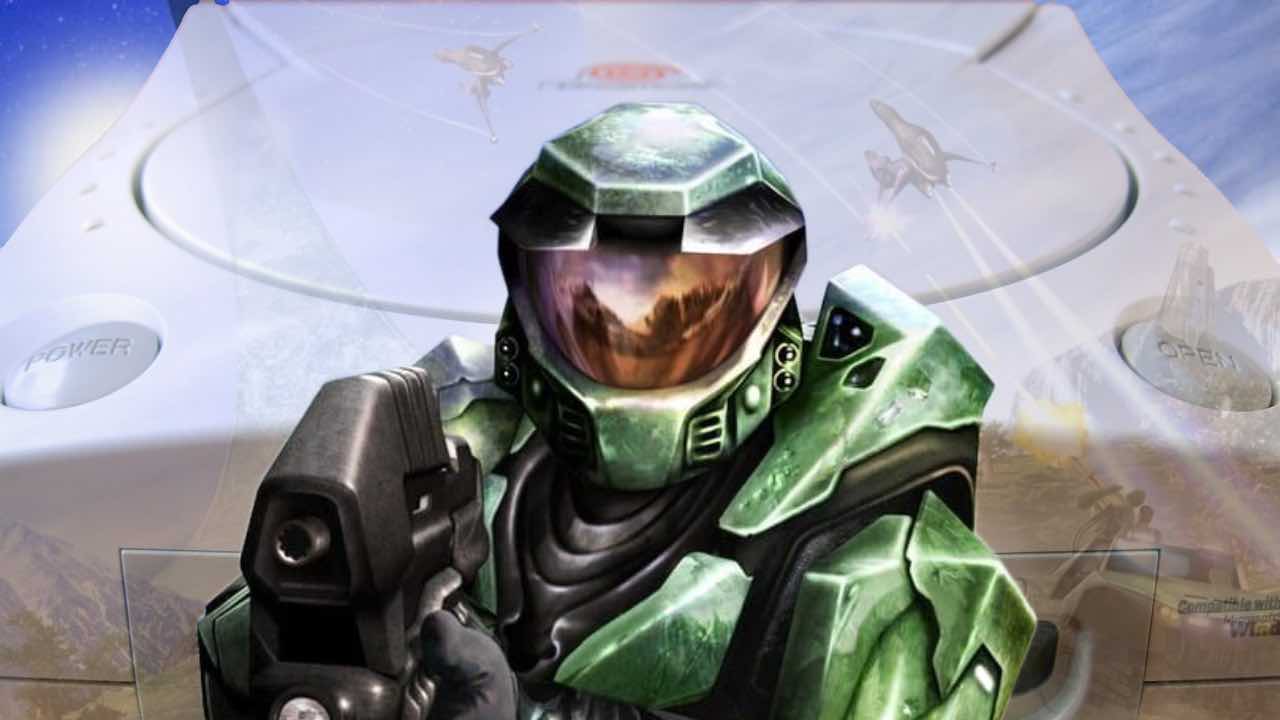
The SEGA Dreamcast continues to push above its weight decades after its discontinuation. As new homebrew ports continue to make their way to SEGA’s short-lived console, a new Halo: Combat Evolved conversion proves just how capable the machine really was.
Following brilliant ports of Star Wars Arcade, World of Warcraft, and even Morrowind, the in-development Halo port is pushing the SEGA Dreamcast to its limits. While some devs are working to bring Halo to the Nintendo Wii and Nintendo 3DS, the SEGA port is even more impressive.
Developed by Jilted Valkyrie, the in-development homebrew mod is attempting to bring every aspect of the original Halo to the Dreamcast. This also includes the cutting-edge graphical features of the 2001 game including its intense lighting effects, shaders, and detailed normal maps that are missing from modern re-releases.
In an update on Twitter, Jilted Valkyrie announced that the Dreamcast port of the flagship Xbox exclusive can now make use of dynamic normal maps. This means that normal maps can be triggered with lighting effects to increase the sense of realism and depth. While still rudimentary in 2026, especially after the launch of GTA 6, it still looks rather incredible.
“We were robbed,” the homebrew developer said online. “I’m honestly impressed AND annoyed at the same time that the Dreamcast can do direction-based normal mapping from dynamic light sources and the console only lasted 2 YEARS!”
While the feature runs really well in emulation, Valkyrie explained that the feature does run worse on real hardware. “This doesn’t run nearly as great on real hardware with all the things Halo is doing. I won’t remove it, but it will be off by default,” the modder said.
The SEGA Dreamcast was the first console to be designed with normal maps in mind. However, very few games actually use the technology on the hardware. While a handful of games do use normal maps, the most known examples are Rayman 2’s grass textures and Shenmue’s metallic textures.
With that said, the technology is still rarely used even in games where it is supported, and none of them have the option to turn the tech on and off depending on dynamic lights. It was an extremely impressive piece of technology in 2001, and it still looks incredible to this day.
However, when it comes to Halo, the game is simply doing too much at once for this feature to run well. Alongside the detailed lighting model, the game is also running complex, CPU-heavy AI that adapts to real-time gameplay. In a simpler game, though, there’s evidence that dynamic normal mapping could work really well on the hardware.
There are other notoriously impressive Dreamcast ports that do make use of this feature to some degree. For example, DOOM 64’s homebrew port makes use of both normal mapping and dynamic lights, but that game is considerably less computationally expensive than the vastness of Halo: Combat Evolved.
The SEGA Dreamcast community has always pushed the hardware long after its death. However, in recent years, the console has been pushed further than ever before, and it shows that the console could’ve continued to compete for at least a few more years after its untimely end.
There are likely games from the era that the SEGA Dreamcast can’t run. For example, I can’t imagine games like Halo 2 or Shadow of the Colossus working very well on the system. With that said, considering how the console’s capabilities continue to be pushed forward, there’s a high chance that will be proven wrong in the future.