Long-time Warhammer 40,000 game designer Jervis Johnson has jumped out of retirement for a number of games, including the brand-new sci-fi sports title DreadBall: All-Stars. An entry-level, fast-paced tabletop title with pre-assembled miniatures, All-Stars is a culmination of decades of game design lessons in one small package.
While Johnson is back designing DreadBall: All-Stars, a Godzilla RPG, and more, the iconic tabletop designer is largely known for his work on Blood Bowl and Warhammer 40,000. As a designer that started at Games Workshop years before 40K was released, Johnson has been shocked by the recent rise in popularity of the tabletop game.
In an interview with FRVR, Johnson explained that he never expected the tabletop game to become anywhere near as big as it currently is. Alongside discussing his thoughts on AI—which was described as the “asbestos of the internet”, Johnson discussed the seemingly unstoppable popularity of Warhammer 40,000.
“No, no, no, no, absolutely not,” Johnson responded when asked if they ever expected Warhammer to become so popular. “I don’t think any of us did. Basically, if you look back in the day, I mean, it was the same—we were nerds and geeks, you know, playing these weird little games. From my generation of the games—that’d be me, Richard Halliwell [who is] sadly no longer with us, Bryan Ansell, again sadly no longer with us—all of the people who were there originally, we’d been playing tabletop war games and making up our own fantasy and science fiction stuff because most of the tabletop war gaming then was historical.”
Johnson explained that, to them, the hobby of taking tabletop figurines and playing a model scale of war was “cool, not in a kind of like jocks kind of way”, but they “found it very satisfying and interesting and deep”. Now, tabletop gaming isn’t really seen as this horrendously nerdy activitiy by the masses—muscle-ripped movie star Henry Cavill plays Warhammer, Amazon is making a TV series based on the show. Simply put, it’s just another hobby, and a very profitable one.
“Games Workshop and a lot of other companies, Mantic [who produce DreadBall: All-Stars], just about all of the miniature games companies that I’ve met, there’s almost like an evangelical zeal, you’re trying to get this hobby out there to as many people as possible,” Johnson said. “That was the aim. This level of success, I don’t think any of us anticipated because, I mean, it wasn’t planned in that way.”
“When 40K launched, Space Marines were immediately the thing that people fixated on.”
Warhammer 40,000 designer Jervis Johnson on the game’s popularity
While tabletop gaming and all of Games Workshop’s products are more popular than ever right now, Warhammer 40,000 specifically feels like an industry into itself. When it launched, 40K immediately became the go-to tabletop game of its era which Johnson attributes to the fact that “it fitted the zeitgeist in terms of the background, and the way that it looked, and its tone”.
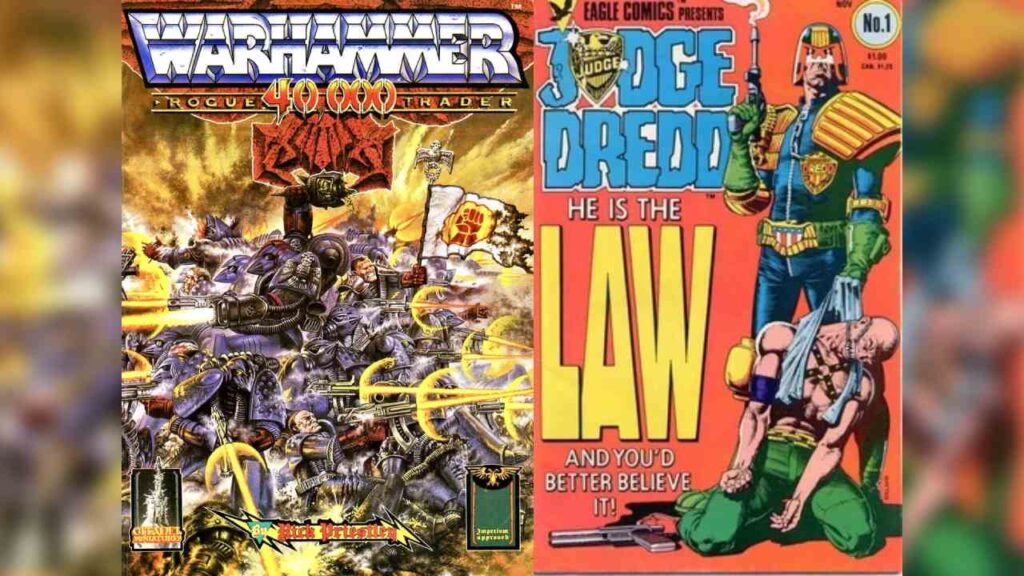
“Particularly in the UK, and to an extend in America,” he continued. “It was very, you know, that tmie in the 80s you’re looking at things like it’s quite a dystopian kind of period. Comics like 2000AD were very popular, Judge Dredd, you’ve got a lot of stuff like that. And 40K’s bckground fit that really well, and I think Rick [Priestley] just did an absolutely magnificent job of creating this different sort of world.”
“Warhammer was very popular, but the Warhammer world you could see that it was kind of like it had its roots in Tolkein and Dungeons and Dragons, you know? As it grew, we managed to kind of like shift it away from there. So, I think Warhammer: The Old World, Age of Sigma now, they’re their own thing… whereas 40K just came out and it was this: ‘What the hell is going on here? It’s just mad!’ You’ve got this monastic Space Marines fighting aliens [and] that first quote, ‘there’s only war’. It’s very bleak kind of view, and in a universe where demons are literally real and there are aliens trying to kill you, the ends justify the means… it was backed up with a really unique set of miniatures.”
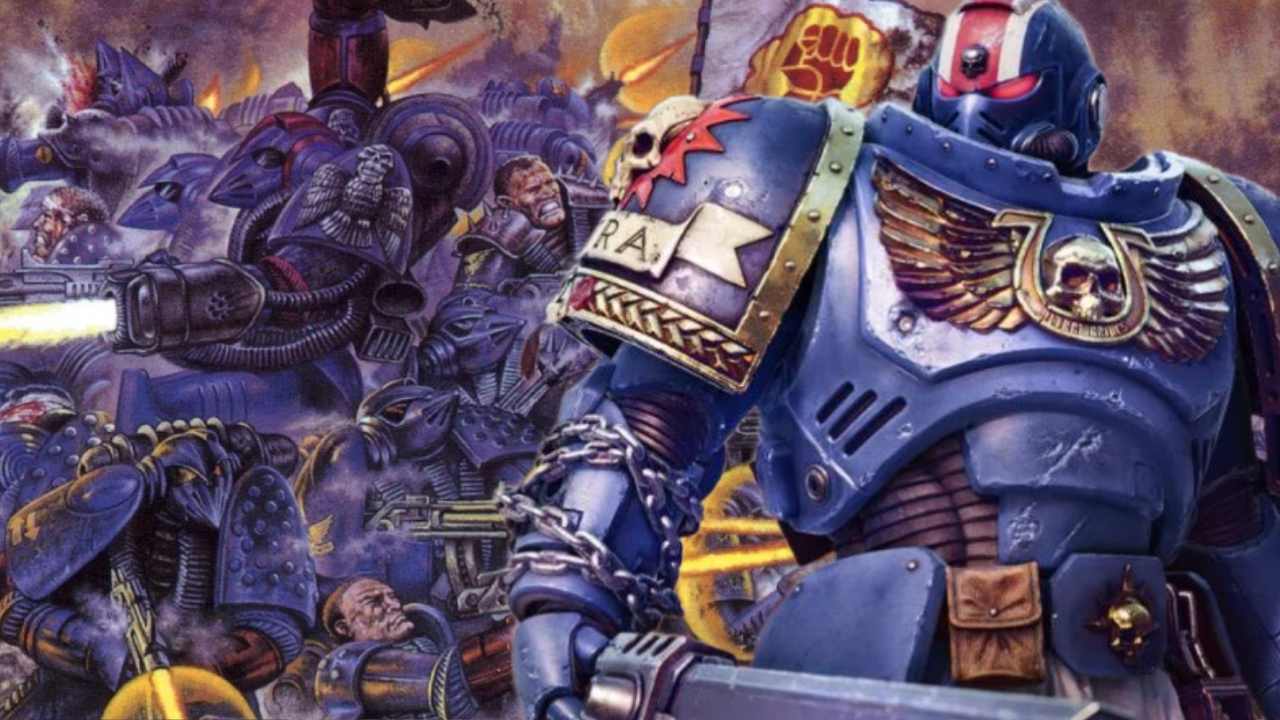
Johnson explained that Warhammer 40,000 was more of its own thing in comparison to The Old World of Warhammer Fantasy. While the fantasy tabletop was very popular, 40K had its own iconography, and the success of the series can largely be tied to the absolute cult icon monolith of the Space Marine.
“The design of the Space Marines, the look of them was very important,” Johnson said. “But I think that the other thing that was important as well was that pretty much all of the designers, the design team actually, pretty much all of Game’s Workshop came from a tabletop miniature gaming background. We collected armies and painted them and we understood the important of uniform guides with background, epaulette, shield designs for your Ancient Romans. That was something we’d grown up being fascinated by and really interested in because it’s just a cool part of our hobby and we wanted that to be part of the 40K hobbies.”
Johnson explained that, alongside the canon designs, allowing players to just make their own chapters using whatever paints and designs they wanted was also important. Tabletop gaming, at the end of the day, is largely an art of expression as well as a game, and that is just as important to the longevity and popularity of Warhammer in general as rulesets and canon is.
“We don’t lock you in to saying you’ve got to paint all Space Marines blue, like we just go with the Ultramarine so they’re all like this, and they’re always like that,” he said. “Right from the get-go, it was designed so that we say, ‘well, here are some examples of the stuff you can do, but actually it’s really up to you. If you want to create your own chapter, the you can.”
The creation of Warhammer 40,000 was the culmination of tabletop fans coming together to put everything they loved about tabletop gaming into one package, a package that would evolve and expand over decades of its own. Johnson explained that Space Marines were by no means an original concept—”it’s not like power-armoured science fiction troopers were something we invented you’ve got the going back to science fiction stories in the 30s”—but the 40K that was released was a combination of what the designers behind the game already loved. Nevertheless, that iconic Space Marine design was also key to the game’s success.
“When 40K launched, Space Marines were immediately the thing that people fixated on,” he said. “They were on the cover, but even so it was above that. They’ve always been the excited thing, you know, they just sell incredibly well, and they’re hugely popular.”
Warhammer and Warhammer 40,000 is bigger than ever, and that can be attributed to its multitude of video games—something Johnson admits is likely one of the major reasons behind its current boon—or maybe its just because Space Marines and 40K have been just part of sci-fi nerd culture for so long.
While Johnson and his peers were the “nerds” of their time, it’s now cool to just like what you like. Video games make more money than Hollywood, Dungeons and Dragons’ Baldur’s Gate franchise is getting a major HBO series, and Warhammer 40,000 is coming to Amazon Prime. Tabletop fans are no longer ashamed of what they like, and 40K can expand into the monolith it is today.