
While Valve’s Steam storefront is taking the brunt of the assault, PC gaming marketplaces are all being actively flooded with quick AI games, including Itch.io.
The use of GenAI in game development is a controversial one. There are some high-quality games that do make use of the tech, such as Arc Raiders, but there are now thousands of quick, churned out games made with GenAI tech that are ravaging online storefronts.
Earlier this year, Steam’s annual Next Fest celebration was despoiled by a slew of AI generated games. While Steam may be under the spotlight for these issues due to its popularity, independent game storefront Itch.io is also suffering.
While Itch.io is mostly known for its indie games, the platform has become more than that. In fact, the online marketplace is often used for selling assets, comic books, soundtracks, and more. With so many options for what to sell, the marketplace has been slammed with spam AI games, models, soundtracks, and more over the last gfew months.
In a statement on social media, Itch.io confirmed that it has started removing thousands of AI-made games and asstes from the marketplace. “Just deleted a couple terabytes of AI slop,” the store said on Twitter. When asked about the situation as many titles are now using some form of AI, the storefront explained that much of the “slop” can be seen as mere spam.
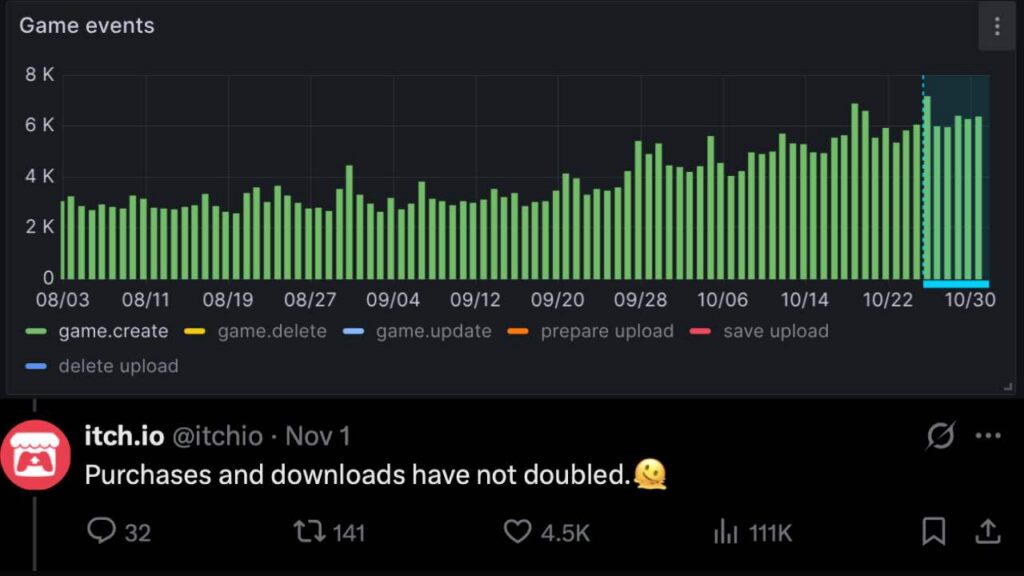
In a previous statement, the marketplace confirmed that “the number of game pages being created per day has doubled in the past two months”. With AI, many are shovelling out spam games to flood the marketplace in an attempt to make any number of sales. Despite the higher number of game pages, the company confirmed “purchases and downloads have not doubled”, meaning no one on the platform is interested in the AI slop.
This issue has also extended to other aspects of the Itch.io storefront, including assets sold to assist developers with their own games. “Just because you can upload 10 terabytes of poorly optimised AI generated models doesn’t mean you should upload 10 terabytes of poorly optimised AI generated models,” the company said on the social media platform.
In response to the rise in AI, Itch.io has also updated its AI disclosure requirements. While games have required users to mark whether or now GenAI was used for the past two years, now everything sold on the marketplace will require the same notifications. This means users will have to mark whether graphics, sounds, text and dialogue, and code were generated with AI.
“The tabletop (aka physical games), books, comics and soundtracks categories on itchio now require completing an AI disclosure in order to edit or create your page,” the company said. Players are also now able to use a “No AI” tag on the website to filter out titles that use the technology.
AI disclosures have proven to be extremely popular with users, although extremely unpopular with those using generative AI. Epic Games CEO Tim Sweeney infamously lambasted Valve’s enforcement of AI disclosures claiming developers are now forced to provide “political statements” on their games. Additionally, VR metaverse VRChat has refused to add AI filters despite 95% of users asking for them.